By teaching our students to think, care, and act, we empower them to build a peaceful future.


Welcome to Think, Care, Act, where teachers and students can find rationales and resources to infuse required curricula with peace, character, global, and multicultural concepts throughout the year.

To act in a world whose problems seem overwhelming requires being able to use the powers of critical and creative thinking and compassionate and inclusive care. Employing these tools, adults and youth alike can work effectively and conscientiously to solve problems big and small, global and local.

Showing posts with label social action. Show all posts

Saturday, November 4, 2017

KIDS CHANGE THE WORLD: LOCAL & GLOBAL THINK-CARE-ACT PROJECTS (AN UPDATE ON TCAP)


“We overwhelm children with all the suffering and evil in the world, but do we enable them to act?”  

Educator Sister Joan Magnetti

“I learned that you can change the world in small doses, one at a time.” 
Sixth Grade Girl
To act in a world whose problems seem overwhelming requires being able to use the powers of 
critical and creative thinking and compassionate and inclusive care.  Employing these tools, adults and youth alike can act effectively and conscientiously 
to solve problems big and small, global and local.
Susan Gelber Cannon

“Change the world.  Details coming soon.”

At national and international conferences, I introduce teachers to Think-Care-Act Projects, designed to empower students to take informed social action. The workshops help teachers incorporate social-action projects in history classes and school culture.  I invite teachers to include real-world action in their classes at my presentation in Philadelphia at the national Association for Middle Level Educators [AMLE] conference.  Participants learn a manageable Freirean model of social action that incorporates critical and creative thinking, compassionate local and global care, and informed and effective social action.  The resources in this blog enable teachers to help students think, care, and act regarding local and global problems in pragmatic, age-appropriate ways that empower rather than overwhelm them.  
Handouts are linked below. These feature numerous resources to promote critical thinking, compassion, and action and are provided to get kids, teachers, and families started on think-care-act projects.
·               Think-Care-Act Project steps include critically thinking about local and global issues that affect people, animals, and the environment; evaluating personal passions, talents, and signature strengths to select the most cared about issues; formulating and implementing effective action plans with achievable goals; communicating actions taken; and evaluating effectiveness.

Sixth Graders Change the World with Think-Care-Act Projects : An timeline of classroom projects
To make a difference in a world whose problems seem overwhelming requires being able to use the powers of critical and creative thinking and compassionate and inclusive care.  Employing these tools, adults and youth alike can act effectively and conscientiously to solve problems big and small, global and local.  Sixth graders showed they are ready to tackle problems of all sizes with their Think-Care-Act Projects.
Here's how we've done it at my school, The Episcopal Academy.  Just before spring break, sixth grade history teachers pique their students’ curiosity with a seemingly simple homework assignment: “Change the world.  Details coming soon.”
In my classes, via role-plays, games and videos, I introduce students to the Universal Declaration of Human Rights and to such activists as Nobel Peace Prize laureates.  We visit websites like PeaceJam and Roots and Shoots, and I show students photos and brochures of previous Think-Care-Act Projects. 


For several weeks, under their teachers’ guidance, sixth graders think deeply about their unique talents, hobbies, qualities, and values they can employ in changing the world for the better.  Helpfully, we have worked on identifying and using our signature strengths all year, inspired by the work of Martin Seligman and the Values in Action team.
Having considered their signature strengths, they next consider the problems involving people, animals, and the environment that draw them to action.  Many students involve their families in discussions of worthy causes and action.  Some students opt to involve themselves in family causes.  Eventually, students combine their unique skill-sets with their passions for service as they embark on research and social-action projects that culminate with each student making a difference at school and in the community.
In 2004 I had introduced the project to my sixth grade history students calling it the Citizenship Action Project.  Character educator Dr. Usha Balamore, adopted the project for the entire fifth grade at The Shipley School, changing the name in honor of my book title and the steps of the project.  Thus, in 2014 (the ten-year anniversary) our history-class final project at EA became the Think-Care-Act Project or TCAP.  The name stuck, and it now involves our school’s entire sixth grade with the guidance of my fellow history teachers.
Why does a social action project belong in a history class curriculum?  Said a former student, “All year we’ve been studying people who made history.  Finally we get to make history ourselves.”

Making history ourselves
Projects have been as varied as the students themselves.  Students have worked alone and in small groups, researching issues, learning about root causes, contacting organizations active in solutions, taking hands-on action, and preparing to teach their peers about their topics.  Introduced in March, the culminating event is the Think-Care-Act Fair held in Middle School in May.  At this event, sixth grade “experts” teach Lower and Middle School visitors, teachers, and family members how they, too, can change the world.  
Melanie and Skylar researched the problems of poverty in the local community.  Their research led them to an organization called Our Closet that provides clothing to people who cannot afford to buy clothing.  “I cared about Our Closet because it allows people to look nice for jobs and to support their families,” says Melanie.  She and Skylar spoke to twelve Lower School classes about the organization, collected bags of clothing at school, and collected a truckload of clothing at an off-campus site.  “I care personally about this problem because I realized how many clothes I have and how little others have,” Skylar reflected.
Aiden advocated for the Gift of Life Donor Program, educating classmates and adults about the need for organ and tissue donors.  He participated in a 5K Donor Dash and used social media, including a blog.  “I was able to spread my message to people in Africa, Bermuda, and all over the United States.  I realize I may just be a kid, but anyone can make a difference,” said Aiden.
Adam and Emily sang at a senior center, employing their love of music to bring joy to others.  An audience member told Adam, “Son, you made me smile today.”  Adam realized, “It made me feel good to know that by doing something that makes me happy I could affect others as well.”
Matthew knows someone who uses a Seeing-Eye dog, and of course, he knows Einstein, one of our school’s own Seeing-Eye-puppies.  He combined his love of animals with his love for people as he and Mrs. Fran McLaughlin took Einstein to visit residents of a retirement home.  He also taught his peers about the Seeing Eye training process.  In another animal project, Torrie and Paige created a slogan, “Unleash joy with a homemade toy,” as they created hand-made toys for the dogs and cats at the local SPCA. 
Intrepid gardeners Will and Drew taught composting and gardening, impressing their peers with organic lettuce they raised in backyard gardens.  That TCAP project led Will to oversee composting in his household for the next three years.  He was quite proud that it reduced the family's trash output to one bag a week.  

Grace researched the issue of e-waste.  “Electronic waste is bad for the environment because when e-waste is put in landfills or incinerators it releases certain toxins into the air” and wastes useful materials.  She learned about our school’s e-waste policies and taught her classmates about community recycling programs.  “I care about this problem because of my passion for technology and my love of the Earth,” reflected Grace on her project choice.  

Other environmentally focused projects included Justin’s work to monitor water quality in fishing streams and the efforts of Natalie and Katie to educate neighbors and peers about the importance of protecting bats by building bat houses.  “Bats are important to the world,” states Katie.  “They eat pounds and pounds of mosquitoes and other insects.”  Natalie concurs, “This prevents some diseases from spreading to humans.”

Projects ranged from teaching how to save a life in an emergency, to how to prevent bullying, to how to train a dog, to how to adopt an animal from a shelter, to how many calories are in chicken patty lunch—and why it matters.

A new twist: middle school students teach college students

At NCSS in 2014, I met Dr. Elizabeth O. Crawford, an education professor at University of North Carolina Wilmington.  We began a partnership that involved my middle school "veterans" of TCAPs teaching her pre-service elementary education teachers how to conduct TCAPs themselves.  Through video sessions between our classrooms in Pennsylvania and North Carolina, students shared projects, teaching ideas, and advice.  


(See videos of our teaching sessions below, and read about our efforts and her students' projects in my July 2015 and July 2016 guest post series.)


Educator Sister Joan Magnetti asked, “We overwhelm children with all the suffering and evil in the world, but do we enable them to act?”  The Sixth Grade Think-Care-Act Project does just that. 
--Susan Gelber Cannon
November 2014, November 2016, & November 2017


LINKS TO RESOURCES:  
1. Kids Change the World: Local and Global Think-Care-Act Projects, Workshop HANDOUT with SLIDES: Session 1346, Association for Middle Level Educators [#AMLE2017], Philadelphia, PA, November 2017, Monday, November 6, 2:30 PM

2. CHANGE THE WORLD: SUE CANNON & USHA BALAMORE'S NATIONAL FORUM ON CHARACTER EDUCATION HANDOUT WITH SLIDES: Washington, DC, October 2016

3. CHANGE THE WORLD: SUE CANNON'S NCSS WORKSHOP HANDOUT : Classroom handouts for Nobel Peace Prize Bingo, Human Rights Role Plays, and Think-Care-Act Project directions (including student sample work), as well as slides for #NCSS2014 Session 493.

4. PeaceJam-How to Start video Good 2-minute intro to the process of informed action

5. Do Something: Causes Website  Selection of various arenas in which to take action

6. Susan Cannon's middle school students teach Dr. Elizabeth Crawford's pre-service teaching class how to do Think-Care-Act Projects Video introduces peace education, human rights, and social action concepts, featuring middle school student activists and future teachers collaborating and learning from each other.

Thursday, June 18, 2015

GUEST POST #4: Helping the Homeless: Animal and Human (EA/UNCW Think-Care-Act Project Partnership)

Introduction

Dr. Elizabeth O. Crawford and I met at the 2014 National Conference for Social Studies.  I presented a session, Change the World: Local and Global Think-Care-Act Projects, and Dr. Crawford, an education professor at University of North Carolina Wilmington, attended my session.  From our meeting arose our EA/UNCW Think-Care-Act Project Partnership. 

Through the 2014-15 school year, my current and former sixth and seventh grade students at The Episcopal Academy “taught” Dr. Crawford’s senior pre-service education majors how to think about personal qualities and talents, identify passions for social change, and act to change the world for the better.  Through Skype and shared project plans, my students and those of Dr. Crawford have inspired and encouraged each other to make a difference.  We are delighted and proud to share the TCAP work of our students, and we will present jointly at NCSS in November 2015.

For Dr. Crawford’s students, the culminating piece of the Think-Care-Act Projects was to write a guest blog post about their projects.  Below, and for the next few blog postings, you will read guest blogs from future teachers, with links for further research and teaching suggestions.  This one by T. Horne and L. Taylor deals with issues of animal and human homelessness—inspirational reading for thinking, caring, and acting!—Sue Cannon


GUEST POST #4: Helping the Homeless: Animal and Human
By Taylor Horne and Lauren Taylor
University of North Carolina Wilmington

As living things, we all need resources to survive: air, food, water, clothing. What about shelter? Something we all need, to be safe, to be warm. But we don't all have it. In every community there are those who have no place to go. If we put our minds and hearts together, we can start a change and make a difference.  In this project, we looked at the issue of homelessness as it affects animals and humans, and we consider how teachers might involve students in working on these issues.

Facts about Homeless Animals

In the United States, there are 70 million stray animals, outnumbering homeless people five to one.  Of the 70 million homeless animals, 6 to 8 million are brought into U.S. shelters each year, most coming from streets, seizures, and families who no longer wish to (or are able to) hold responsibility (HSUS, 2014). Often after large holidays, there is a spike in puppy and kitten numbers in shelters, due to impulsive and unprepared gifting (Dogtime, 2009). In extreme cases of cruelty, animal owners have even been known to leave pets behind when moving (Hope for Paws, 2015). The reality is for all of these cases, 2.7 million of these animals will be euthanized, never receiving a second chance (Pepelko, 2014).

Every year, taxes pay one to two billion dollars for sheltering, euthanizing, and disposal of these animals (Pepelko, 2014). Because funding goes mainly to removal, shelters have minimal resources to protect animals.  The 2.7 million euthanized animals, are considered adoptable by the HSUS (2014), meaning, no circumstances exist delaying adoption.  These animals were loving, healthy, and ready to find a permanent home. For animals entering the shelter with health complications, behavior problems, and abuse history, hardly anything can be done in terms of rehabilitation (Texas Alliance for Homeless Pets, 2013).

Project Potential for Students

By no means do these grotesque numbers need to be shared with young students, but the call for action is there! These animals have lives that are easily forgotten and deserve a better existence. Students may not understand the tragedy behind shelter animals, but they do understand human animal relationships: animals love humans and we love them back. Students can be the factor that changes this equation.

Students can remind the community why the human/animal relationship is important by spreading information, students can collect items to help in the care for these animals, donate their time, or sponsor animals.  Though most students cannot adopt or rehabilitate these animals, sometimes a jar of peanut butter can make the difference in a good or bad day for these animals waiting to find their families.

(Editor’s note: My middle school students have learned that most shelters will not allow students under the age of sixteen to work at a shelter directly with animals.  However, using shelter websites, students can determine shelter needs and can make blankets and toys, collect treats and supplies, and teach their peers about the benefits of adopting from animal shelters.)

Facts about Homeless People

Homelessness affects a wide range of people and is a prominent issue in the United States.  According to National Health Care for the Homeless Council, “A homeless person is an individual without permanent housing who may live on the streets; stay in a shelter, mission, single room occupancy facilities, abandoned building or vehicle; or in any other unstable or non-permanent situation.”  There are several additions to this definition as defined by the Council.  One example is if a person is “doubled up” or living in a friend’s house without paying rent.

In 2013, one in seven people in the U.S. suffered from hunger.  Three-and-a-half million people slept somewhere besides a home, be that a shelter, a park bench, or their car.  Twenty-five percent of those experiencing homelessness are children under the age of eighteen.  Another twenty percent suffer from some type of mental illness.  Twenty-three percent are veterans.  Thirty percent have been victims of domestic violence, and for that reason forced to leave their homes for their own safety.  Thirty-five percent of the homeless population includes families living in poverty as a unit, making their battle to defeat homelessness even more challenging (National Student Campaign Against Hunger and Homelessness, 2011). 

There are three types of homelessness.  Some people are chronically homeless, some are transitionally homeless, and some are episodically homeless.  Chronically homeless people are likely to stay in a shelter for a prolonged period of time, while transitionally homeless people are in shelters only for a short time while they overcome a catastrophic event.  Episodically homeless people are in the shelters when they are homeless, then in other housing arrangements for a period of time, and they essentially switch back and forth.

Taking Action: Providing Help via Homeless Shelters

All three types of homeless people often look to the help provided by shelters during their times of need.  That is why I chose to base most of my actions on shelters themselves.  I made tie blankets with my sorority and we delivered them to the Good Shepard Center because blankets are one of their biggest donation needs.  I am in the application process of having a permanent volunteer position at a local homeless shelter as a receptionist.   I also sponsored a separate event with my sorority where some of us went to serve food to homeless people at another shelter downtown.  We also took various donations to the shelter when we went. 

Additionally, one of my close friends is going to work at a summer camp for high schoolers that want to help the homeless community of Asheville, N.C.  To keep costs low, and the number of campers high, the staff of this camp is asked to raise half of their salary.  I gave her a monetary donation in support of this goal.  I also have spoken with my local library, and I will be setting up a donation box there that I will pick up weekly over the summer and deliver to the homeless shelter in my home town.

Taking Action with Students via Think-Care-Act Projects

Think-Care-Act Art by J. Kadir Cannon
It is important for teachers to empower kids to want to make a difference in their world.  This can be as simple as just telling them that they aren’t too small or too young to do big things!  Incorporating activities like the Think-Care-Act Project into the elementary classroom is a great way to empower kids to make a difference.  This way, they are forced a little bit outside of their comfort zone because they know they have to take action somehow, and they have to make a difference.  This gets them thinking about things they care about, and what their passions are.  If kids can figure this out at a young age, when they are older they will continue to develop those passions and continue taking action for their cause.  Teachers essentially create a chain reaction when they implement these projects into the classroom!

-- Taylor Horne & Lauren Taylor, 2015

Wednesday, November 12, 2014

CHANGE THE WORLD: LOCAL & GLOBAL THINK-CARE-ACT PROJECTS


“We overwhelm children with all the suffering and evil in the world, but do we enable them to act?”  
Educator Sister Joan Magnetti

“I learned that you can change the world in small doses, one at a time.”
Sixth Grade Girl
To act in a world whose problems seem overwhelming requires being able to use the powers of 
critical and creative thinking and compassionate and inclusive care.  Employing these tools, adults and youth alike can act effectively and conscientiously 
to solve problems big and small, global and local.
Susan Gelber Cannon

“Change the world.  Details coming soon.”

At national and international conferences, I introduce teachers to Think-Care-Act Projects, designed to empower students to take informed social action. The workshops help teachers incorporate social-action projects in history classes and school culture.  I invite middle school teachers to include real-world action in their classes at my presentation in Philadelphia at the national Association for Middle Level Educators [AMLE] conference.  Participants learn a manageable Freirean model of social action that incorporates critical and creative thinking, compassionate local and global care, and informed and effective social action.  The resources in this blog enable teachers to help students think, care, and act regarding local and global problems in pragmatic, age-appropriate ways that empower rather than overwhelm them.  
Handouts are linked below. My www.teachforpeace.org website features numerous resources to promote critical thinking, compassion, and action. These and other links are provided to get teachers started on think-care-act projects with students.
·               Think-Care-Act Project steps include critically thinking about local and global issues that affect people, animals, and the environment; evaluating personal passions and talents to select the most cared about issues; formulating and implementing effective action plans with achievable goals; communicating actions taken; and evaluating effectiveness.

Sixth Graders Change the World with Think-Care-Act Projects : An timeline of classroom projects
To make a difference in a world whose problems seem overwhelming requires being able to use the powers of critical and creative thinking and compassionate and inclusive care.  Employing these tools, adults and youth alike can act effectively and conscientiously to solve problems big and small, global and local.  Sixth graders showed they are ready to tackle problems of all sizes with their Think-Care-Act Projects.
Just before spring break, sixth grade history teachers piqued their students’ curiosity with a seemingly simple homework assignment: “Change the world.  Details coming soon.”
For several weeks, under their teachers’ guidance, sixth graders thought deeply about their unique talents, hobbies, qualities, and values they could employ in changing the world for the better.  Having considered their signature strengths, they next considered the problems involving people, animals, and the environment that drew them to action.  They combined their unique skill-sets with their passions for service as they embarked on a research and social-action project that culminated with each student making a difference at school and in the community.
In 2004 I had introduced the project to my sixth grade history students calling it the Citizenship Action Project.  Character educator Dr. Usha Balamore, adopted the project for the entire fifth grade at her school, changing the name in honor of my book title and the steps of the project.  Thus, in 2014, the ten-year anniversary of the history-class final project became the Think-Care-Act Project.  The name stuck, and it now involves our school’s entire sixth grade with the guidance of my fellow history teachers.
Why does a social action project belong in a history class curriculum?  Said a former student, “All year we’ve been studying people who made history.  Finally we get to make history ourselves.”

Making history ourselves
Projects were as varied as the students themselves.  Students worked alone and in small groups, researching issues, learning about root causes, contacting organizations active in solutions, taking hands-on action, and preparing to teach their peers about their topics.  Introduced in March, the culminating event was the Think-Care-Act Fair held in Middle School on May 20.  Sixth grade “experts” taught Lower and Middle School visitors, teachers, and family members how they, too, could change the world.
Melanie and Skylar researched the problems of poverty in the local community.  Their research led them to an organization called Our Closet that provides clothing to people who cannot afford to buy clothing.  “I cared about Our Closet because it allows people to look nice for jobs and to support their families,” says Melanie.  She and Skylar spoke to twelve Lower School classes about the organization, collected bags of clothing at school, and collected a truckload of clothing at an off-campus site.  “I care personally about this problem because I realized how many clothes I have and how little others have,” Skylar reflected.
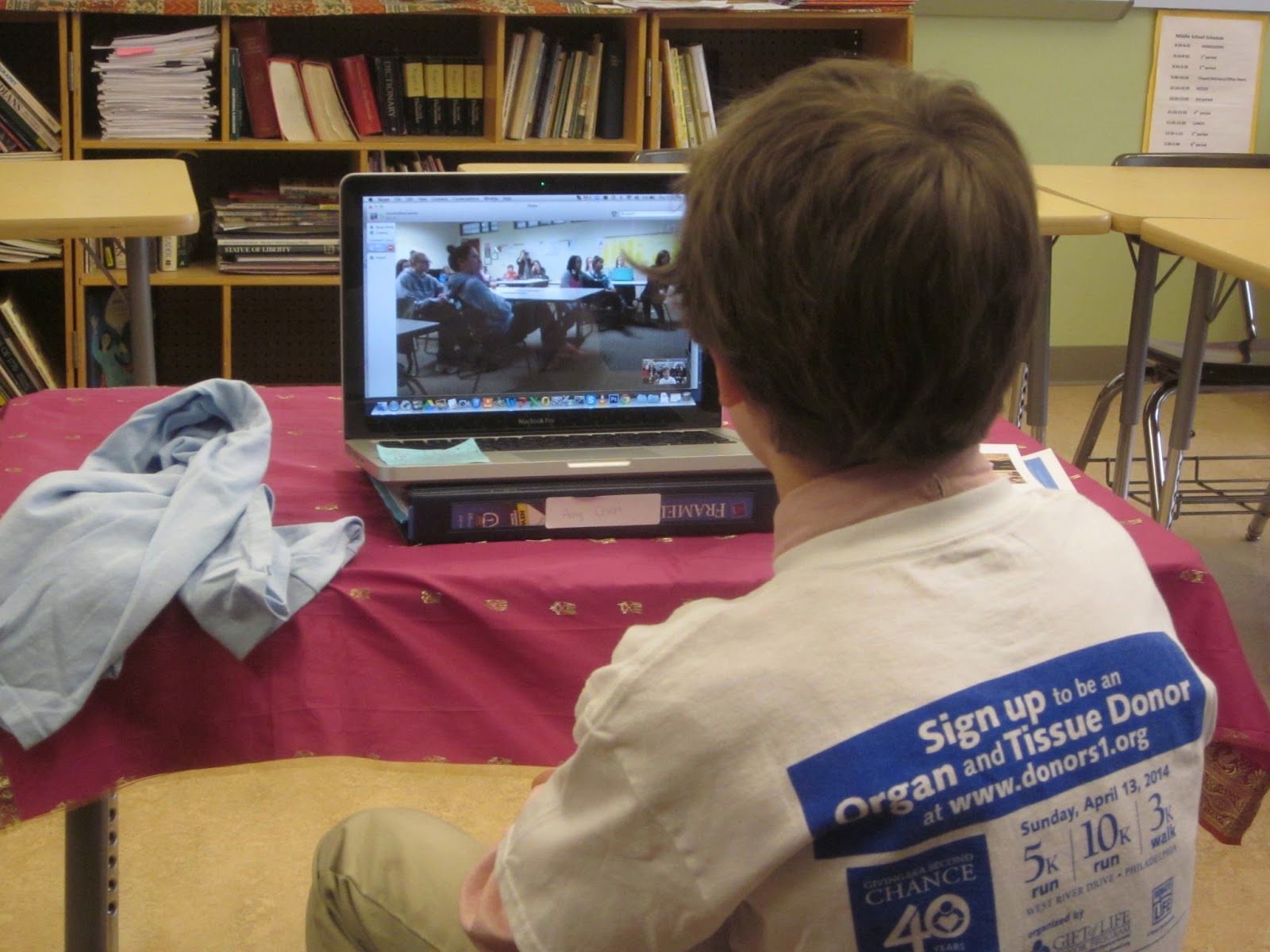
Aiden advocated for the Gift of Life Donor Program, educating classmates and adults about the need for organ and tissue donors.  He participated in a 5K Donor Dash and used social media, including a blog.  “I was able to spread my message to people in Africa, Bermuda, and all over the United States.  I realize I may just be a kid, but anyone can make a difference,” said Aiden.
Adam and Emily sang at a senior center, employing their love of music to bring joy to others.  An audience member told Adam, “Son, you made me smile today.”  Adam realized, “It made me feel good to know that by doing something that makes me happy I could affect others as well.”
Matthew knows someone who uses a Seeing-Eye dog, and of course, he knows Einstein, one of our school’s own Seeing-Eye-puppies.  He combined his love of animals with his love for people as he and Mrs. Fran McLaughlin took Einstein to visit residents of a retirement home.  He also taught his peers about the Seeing Eye training process.  In another animal project, Torrie and Paige created a slogan, “Unleash joy with a homemade toy,” as they created hand-made toys for the dogs and cats at the local SPCA. 
Grace researched the issue of e-waste.  “Electronic waste is bad for the environment because when e-waste is put in landfills or incinerators it releases certain toxins into the air” and wastes useful materials.  She learned about our school’s e-waste policies and taught her classmates about community recycling programs.  “I care about this problem because of my passion for technology and my love of the Earth,” reflected Grace on her project choice.  Other environmentally focused projects included Justin’s work to monitor water quality in fishing streams and the efforts of Natalie and Katie to educate neighbors and peers about the importance of protecting bats by building bat houses.  “Bats are important to the world,” states Katie.  “They eat pounds and pounds of mosquitoes and other insects.”  Natalie concurs, “This prevents some diseases from spreading to humans.”


Projects ranged from teaching how to save a life in an emergency, to how to prevent bullying, to how to train a dog, to how to adopt an animal from a shelter, to how many calories are in chicken patty lunch—and why it matters.


A new twist: middle school students teach college students


At NCSS in 2014, I met Dr. Elizabeth Crawford Outlaw.  We began a partnership that involved my middle school "veterans" of TCAPs teaching her pre-service elementary education teachers how to conduct TCAPs themselves.  (See videos below, and read about our efforts and her students' projects in guest blogs.)

Educator Sister Joan Magnetti asked, “We overwhelm children with all the suffering and evil in the world, but do we enable them to act?”  The Sixth Grade Think-Care-Act Project does just that. 
--Susan Gelber Cannon, November 2014, November 2016, & November 2017

LINKS TO RESOURCES:  
1. Kids Change the World: Local and Global Think-Care-Act Projects, Workshop HANDOUT with SLIDES: Session 1346, Association for Middle Level Educators [AMLE], Philadelphia, PA, November 2017, Monday, November 6, 2:30 PM

2. CHANGE THE WORLD: SUE CANNON & USHA BALAMORE'S NATIONAL FORUM ON CHARACTER EDUCATION HANDOUT WITH SLIDES: Washington, DC, October 2016

3. CHANGE THE WORLD: SUE CANNON'S NCSS WORKSHOP HANDOUT : Classroom handouts for Nobel Peace Prize Bingo, Human Rights Role Plays, and Think-Care-Act Project directions (including student sample work), as well as slides for #NCSS2014 Session 493.

4. TEACH FOR PEACE WEBSITE-Resources for teaching students to think, care, and act for the greater good

5. PeaceJam-How to Start video Good 2-minute intro to the process of informed action

6. Do Something: Causes Website  Selection of various arenas in which to take action

7. Susan Cannon's middle school students teach Dr. Elizabeth Crawford's pre-service teaching class how to do Think-Care-Act Projects Video introduces peace education, human rights, and social action concepts, featuring middle school student activists and future teachers collaborating and learning from each other.