
“We overwhelm children with all the suffering and evil in the world, but do we enable them to act?”
Educator Sister Joan Magnetti
“I learned that you can change the world in small doses, one at a time.”
Sixth Grade Girl
Sixth Grade Girl
To act in a world whose problems seem overwhelming requires being able to use the powers of
critical and creative thinking and compassionate and inclusive care. Employing these tools, adults and youth alike can act effectively and conscientiously
to solve problems big and small, global and local.
Susan Gelber Cannon
“Change the world. Details coming soon.”
At national and international conferences, I introduce teachers to Think-Care-Act Projects, designed to empower students to take informed social action. The workshops help teachers incorporate social-action projects in history classes and school culture. I invite teachers to include real-world action in their classes at my presentation in Philadelphia at the national Association for Middle Level Educators [AMLE] conference. Participants learn a manageable Freirean model of social action that incorporates critical and creative thinking, compassionate local and global care, and informed and effective social action. The resources in this blog enable teachers to help students think, care, and act regarding local and global problems in pragmatic, age-appropriate ways that empower rather than overwhelm them.
Handouts are linked below. These feature numerous resources to promote critical thinking, compassion, and action and are provided to get kids, teachers, and families started on think-care-act projects.
· Think-Care-Act Project steps include critically thinking about local and global issues that affect people, animals, and the environment; evaluating personal passions, talents, and signature strengths to select the most cared about issues; formulating and implementing effective action plans with achievable goals; communicating actions taken; and evaluating effectiveness.


Sixth Graders Change the World with Think-Care-Act Projects : An timeline of classroom projects

To make a difference in a world whose problems seem overwhelming requires being able to use the powers of critical and creative thinking and compassionate and inclusive care. Employing these tools, adults and youth alike can act effectively and conscientiously to solve problems big and small, global and local. Sixth graders showed they are ready to tackle problems of all sizes with their Think-Care-Act Projects.
Here's how we've done it at my school, The Episcopal Academy. Just before spring break, sixth grade history teachers pique their students’ curiosity with a seemingly simple homework assignment: “Change the world. Details coming soon.”


For several weeks, under their teachers’ guidance, sixth graders think deeply about their unique talents, hobbies, qualities, and values they can employ in changing the world for the better. Helpfully, we have worked on identifying and using our signature strengths all year, inspired by the work of Martin Seligman and the Values in Action team.


Why does a social action project belong in a history class curriculum? Said a former student, “All year we’ve been studying people who made history. Finally we get to make history ourselves.”
Making history ourselves

Projects have been as varied as the students themselves. Students have worked alone and in small groups, researching issues, learning about root causes, contacting organizations active in solutions, taking hands-on action, and preparing to teach their peers about their topics. Introduced in March, the culminating event is the Think-Care-Act Fair held in Middle School in May. At this event, sixth grade “experts” teach Lower and Middle School visitors, teachers, and family members how they, too, can change the world.
 Melanie and Skylar researched the problems of poverty in the local community. Their research led them to an organization called Our Closet that provides clothing to people who cannot afford to buy clothing. “I cared about Our Closet because it allows people to look nice for jobs and to support their families,” says Melanie. She and Skylar spoke to twelve Lower School classes about the organization, collected bags of clothing at school, and collected a truckload of clothing at an off-campus site. “I care personally about this problem because I realized how many clothes I have and how little others have,” Skylar reflected.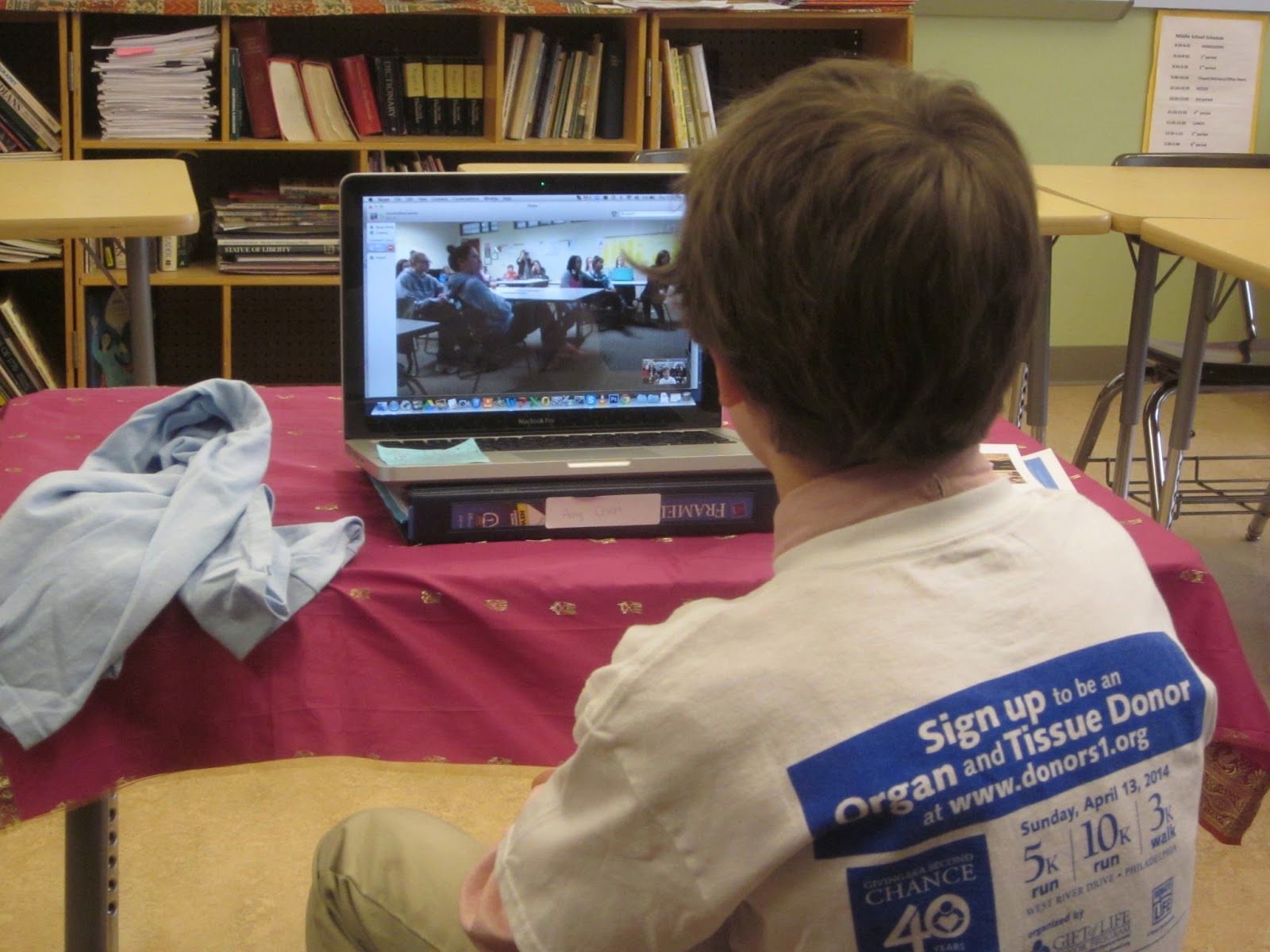
Adam and Emily sang at a senior center, employing their love of music to bring joy to others. An audience member told Adam, “Son, you made me smile today.” Adam realized, “It made me feel good to know that by doing something that makes me happy I could affect others as well.”

Matthew knows someone who uses a Seeing-Eye dog, and of course, he knows Einstein, one of our school’s own Seeing-Eye-puppies. He combined his love of animals with his love for people as he and Mrs. Fran McLaughlin took Einstein to visit residents of a retirement home. He also taught his peers about the Seeing Eye training process. In another animal project, Torrie and Paige created a slogan, “Unleash joy with a homemade toy,” as they created hand-made toys for the dogs and cats at the local SPCA.

Grace researched the issue of e-waste. “Electronic waste is bad for the environment because when e-waste is put in landfills or incinerators it releases certain toxins into the air” and wastes useful materials. She learned about our school’s e-waste policies and taught her classmates about community recycling programs. “I care about this problem because of my passion for technology and my love of the Earth,” reflected Grace on her project choice.
Other environmentally focused projects included Justin’s work to monitor water quality in fishing streams and the efforts of Natalie and Katie to educate neighbors and peers about the importance of protecting bats by building bat houses. “Bats are important to the world,” states Katie. “They eat pounds and pounds of mosquitoes and other insects.” Natalie concurs, “This prevents some diseases from spreading to humans.”
A new twist: middle school students teach college students
 At NCSS in 2014, I met Dr. Elizabeth O. Crawford, an education professor at University of North Carolina Wilmington. We began a partnership that involved my middle school "veterans" of TCAPs teaching her pre-service elementary education teachers how to conduct TCAPs themselves. Through video sessions between our classrooms in Pennsylvania and North Carolina, students shared projects, teaching ideas, and advice.
(See videos of our teaching sessions below, and read about our efforts and her students' projects in my July 2015 and July 2016 guest post series.)
Educator Sister Joan Magnetti asked, “We overwhelm children with all the suffering and evil in the world, but do we enable them to act?” The Sixth Grade Think-Care-Act Project does just that.
--Susan Gelber Cannon
November 2014, November 2016, & November 2017

November 2014, November 2016, & November 2017

LINKS TO RESOURCES:
1. Kids Change the World: Local and Global Think-Care-Act Projects, Workshop HANDOUT with SLIDES: Session 1346, Association for Middle Level Educators [#AMLE2017], Philadelphia, PA, November 2017, Monday, November 6, 2:30 PM2. CHANGE THE WORLD: SUE CANNON & USHA BALAMORE'S NATIONAL FORUM ON CHARACTER EDUCATION HANDOUT WITH SLIDES: Washington, DC, October 2016
3. CHANGE THE WORLD: SUE CANNON'S NCSS WORKSHOP HANDOUT : Classroom handouts for Nobel Peace Prize Bingo, Human Rights Role Plays, and Think-Care-Act Project directions (including student sample work), as well as slides for #NCSS2014 Session 493.
4. PeaceJam-How to Start video Good 2-minute intro to the process of informed action
5. Do Something: Causes Website Selection of various arenas in which to take action
6. Susan Cannon's middle school students teach Dr. Elizabeth Crawford's pre-service teaching class how to do Think-Care-Act Projects Video introduces peace education, human rights, and social action concepts, featuring middle school student activists and future teachers collaborating and learning from each other.


