By teaching our students to think, care, and act, we empower them to build a peaceful future.


Welcome to Think, Care, Act, where teachers and students can find rationales and resources to infuse required curricula with peace, character, global, and multicultural concepts throughout the year.

To act in a world whose problems seem overwhelming requires being able to use the powers of critical and creative thinking and compassionate and inclusive care. Employing these tools, adults and youth alike can work effectively and conscientiously to solve problems big and small, global and local.

Showing posts with label PeaceJam. Show all posts

Sunday, October 6, 2019

THE COST OF WAR SINCE 9-11-2001 (AND TOOLS TO WORK FOR PEACE)

Visiting the 9-11 Memorial for the first time, I perceived that the waterfall represented a torrent of tears to allow visitors to mourn and find solace.  

Photo by Peter Lalor 

Photo by Susan Cannon
However, I did not perceive that the monument would encourage visitors to atone for all violence and to work for peace among all people. I bemoaned the lost potential of the “9-11-moment” to enable the United States forge alliances of good will and peace immediately after the disaster.  I recalled my visit to Hiroshima, Japan, and the Peace Park’s overwhelming message: “Never again.”

Sadly, since 9-11-2001, according to the Brown University Watson Institute for International and Public Affairs’ 2018 “Costs of War” report, the United States has spent nearly $6 trillion on wars that have contributed to the deaths of around 500,000 people since the 9/11 attacks.  How many of us consider these staggering figures?  How many of us teach about them?

The annual report considers obvious and hidden war-related spending, including obligations for veterans’ care, debt, reconstruction costs, and the long-term effect on the U.S. economy. "The United States has appropriated and is obligated to spend an estimated $5.9 trillion (in current dollars) on the war on terror through Fiscal Year 2019, including direct war and war-related spending and obligations for future spending on post 9/11 war veterans…."

The study concludes: "In sum, high costs in war and war-related spending pose a national security concern because they are unsustainable. The public would be better served by increased transparency and by the development of a comprehensive strategy to end the wars and deal with other urgent national security priorities."

These are just the economic costs. What about the human costs? The Brown University report states: “All told, between 480,000 and 507,000 people have been killed in the United States’ post-9/11 wars in Iraq, Afghanistan, and Pakistan. This tally of the counts and estimates of direct deaths caused by war violence does not include the more than 500,000 deaths from the war in Syria, raging since 2011, which the US joined in August 2014.”  The study goes on to discuss indirect deaths of civilians, journalists, and humanitarian workers, and ongoing human rights abuses, deterioration of the environment, displacement of citizens, and unsafe conditions for refugees.
  

Learn and Teach about the 9-11 Memorial 

When I taught middle school, I started each September with lessons on the 9-11 attack, focusing on past uses of terror (including by the Ku Klux Klan, a white, Christian terrorist group). I wanted my students to understand that terrorists are not from one race, religion, creed, or national background.  We analyzed media coverage and discussed ways various media manipulate consumers with hyperbole.  We observed the difference between information and sensationalism.  We discussed the difference between patriotism and nationalism, the resilience and determination of first responders and survivors, and the resolve students young and old can show as we work for a peaceful world.  The unit culminated in action coordinated with the International Day of Peace, commemorated annually on September 21.

In response to my visit to the 9-11 Memorial, I offer the following resources to teachers.  It is urgent that we take every opportunity to help our students understand the costs of violence and war and our ability and duty as citizens to prevent it.  The memorial offers us an entry to these lessons.


The memorial is somber and beautiful. I have shown videos of interviews with the architect Michael Arad to my students, and they have appreciated his goals. Links are below to help students envision the memorial through the eyes of the designer. Arad told ABC news he wanted to “create a place that allowed people to come together to reflect on what happened here, not alone but as a community in a public space where people gather and congregate…. Could I bring that idea of emptiness, this continuous presence, and making absence present and visible, and tangible to the site?” 

The 9-11 Memorial Website has deep education resources, including well-articulated goals that include ongoing research into the events of 9-11-2001, critical thinking about the aftermath, and promoting civic engagement and volunteerism. Lesson plans for various grade levels include such topics as grieving and heroism, making a memorial, and critical thinking about such topics as “airport security versus civil liberties.” 

·      9-11-Memorial & Museum Website Homepage: https://www.911memorial.org/memorial

·      Education Goals: https://www.911memorial.org/education-goals
·      Lesson Plans for various grade levels include critical thinking opportunities to allow students to explore topics such as “airport security versus civil liberties.” https://www.911memorial.org/lesson-plans

·      Architect Michael Arad’s Interview with ABC News Article (Good summary of designer’s goals): https://abcnews.go.com/blogs/headlines/2012/09/911-memorial-offers-quiet-amid-new-york-chaos-designer-michael-arad-says/

·      Studio 360’s 4-Minute Video: 9/11 Memorial Tour With Architect Michael Arad  https://www.youtube.com/watch?v=5xBfiJkratE

Making Absence Visible: Michael Arad at TEDxWall Street (12-Minute Video) https://www.youtube.com/watch?v=tLKWiEeLIsU

Learn and Teach about the Cost of War

Painting by J. Kadir Cannon
If we and our students knew the true costs of war on soldier and civilian alike, on our environment, on our nation’s aging infrastructure, on our education and healthcare systems, on the potential for global security, and more—would we continue to support the military-industrial complex and its incessant drive to war?  I don’t think so.  It is our duty to learn and teach about the true costs of war.  These links are a good place to start.
Painting by J. Kadir Cannon

·      Brown University Costs of War Homepage: https://watson.brown.edu/costsofwar/

  • GOALS of the Costs of War Project: The project aims to help students consider alternatives to war and the long-term effects of war on the United States and the world in terms of economic, public health, and other human and ecological costs. Goals also include exploring how “to identify less costly and more effective ways to prevent further terror attacks.” (6-minute video) https://watson.brown.edu/costsofwar/about

·      Costs of War: Concise Summary: https://watson.brown.edu/costsofwar/papers/summary

·      Costs of War Overview: https://watson.brown.edu/costsofwar/figures

·      Human Cost of War: the Human Toll of the Post 9-11 Wars (4-minute Video): https://www.youtube.com/watch?v=aVr0MSEW2SU

·      Newsweek article: U.S. HAS SPENT SIX TRILLION DOLLARS ON WARS THAT KILLED HALF A MILLION PEOPLE SINCE 9/11, REPORT SAYS  Newsweek’s November 2018 Article on Brown University Report with charts and graphics helpful for analyzing data is best viewed on laptop or projected for discussion with students.  https://www.newsweek.com/us-spent-six-trillion-wars-killed-half-million-1215588

Learn and Teach about Civic Action


I’ve often quoted educator Sister Joan Magnetti's query: “We overwhelm children with all the suffering and evil in the world, but do we enable them to act?” Indeed, we must empower our students (and ourselves) to take action, even against seemingly insurmountable institutions such as militarism and war. These links are a good place to begin empowering students to take action large and small in their local and global communities.  Let's turn a torrent of tears into a torrent of action. 


·      Washington Post article: WHAT AMERICA COULD DO WITH EUROPEAN LEVELS OF MILITARY SPENDING  “Depending on which expert you ask, the chronic social ills the United States could go a long way toward addressing with an extra $3 trillion per decade include: homelessness, child poverty, college tuition costs, the national student debt burden, a lack of affordable child care and long-term health care for the elderly. It could also accomplish several key goals of the president, or go a long way to help balancing U.S. books….”   https://www.washingtonpost.com/business/2018/07/12/what-america-could-do-with-european-levels-military-spending/

·      American Friends Service Committee links to Wage Peace: “Wage Peace uses creative and visual grassroots education and organizing to develop new constituencies for the intersection of peace and justice work, as we work toward a broadened and diversified movement of people who will support policies that challenge militarism at home and abroad, and support the growth and well-being of communities with their policymakers at all levels.”  https://www.afsc.org/key-issues/campaign/wage-peace

o   Humanize not Militarize Educational Toolkit: https://www.afsc.org/resource/humanize-not-militarize-training-resources

·      Friends Committee on National Legislation has tools for approaching Congressional representatives on war budget issues

·      Jane Goodall’s Roots and Shoots aims “to empower young people to affect positive change in their communities:” https://www.rootsandshoots.org

·      PeaceJam (Nobel Peace Prize Winners and Youth) Founders Dawn and Engel and Ivan Suvanjieff assert that “average, ordinary people can tackle the toughest issues facing humanity.”  http://www.peacejam.org
o   Billion Acts of Peace links to examples of youth action on demilitarization, clean environment, human rights, global health and wellness, conflict resolution, and more. https://billionacts.org

·      Sue Cannon’s Middle School lessons on media literacy from 9-11 to 9-21: https://thinkcareact.blogspot.com/2012/09/investigating-media-from-september-11.html

Susan Gelber Cannon, October 2019

Saturday, November 4, 2017

KIDS CHANGE THE WORLD: LOCAL & GLOBAL THINK-CARE-ACT PROJECTS (AN UPDATE ON TCAP)


“We overwhelm children with all the suffering and evil in the world, but do we enable them to act?”  

Educator Sister Joan Magnetti

“I learned that you can change the world in small doses, one at a time.” 
Sixth Grade Girl
To act in a world whose problems seem overwhelming requires being able to use the powers of 
critical and creative thinking and compassionate and inclusive care.  Employing these tools, adults and youth alike can act effectively and conscientiously 
to solve problems big and small, global and local.
Susan Gelber Cannon

“Change the world.  Details coming soon.”

At national and international conferences, I introduce teachers to Think-Care-Act Projects, designed to empower students to take informed social action. The workshops help teachers incorporate social-action projects in history classes and school culture.  I invite teachers to include real-world action in their classes at my presentation in Philadelphia at the national Association for Middle Level Educators [AMLE] conference.  Participants learn a manageable Freirean model of social action that incorporates critical and creative thinking, compassionate local and global care, and informed and effective social action.  The resources in this blog enable teachers to help students think, care, and act regarding local and global problems in pragmatic, age-appropriate ways that empower rather than overwhelm them.  
Handouts are linked below. These feature numerous resources to promote critical thinking, compassion, and action and are provided to get kids, teachers, and families started on think-care-act projects.
·               Think-Care-Act Project steps include critically thinking about local and global issues that affect people, animals, and the environment; evaluating personal passions, talents, and signature strengths to select the most cared about issues; formulating and implementing effective action plans with achievable goals; communicating actions taken; and evaluating effectiveness.

Sixth Graders Change the World with Think-Care-Act Projects : An timeline of classroom projects
To make a difference in a world whose problems seem overwhelming requires being able to use the powers of critical and creative thinking and compassionate and inclusive care.  Employing these tools, adults and youth alike can act effectively and conscientiously to solve problems big and small, global and local.  Sixth graders showed they are ready to tackle problems of all sizes with their Think-Care-Act Projects.
Here's how we've done it at my school, The Episcopal Academy.  Just before spring break, sixth grade history teachers pique their students’ curiosity with a seemingly simple homework assignment: “Change the world.  Details coming soon.”
In my classes, via role-plays, games and videos, I introduce students to the Universal Declaration of Human Rights and to such activists as Nobel Peace Prize laureates.  We visit websites like PeaceJam and Roots and Shoots, and I show students photos and brochures of previous Think-Care-Act Projects. 


For several weeks, under their teachers’ guidance, sixth graders think deeply about their unique talents, hobbies, qualities, and values they can employ in changing the world for the better.  Helpfully, we have worked on identifying and using our signature strengths all year, inspired by the work of Martin Seligman and the Values in Action team.
Having considered their signature strengths, they next consider the problems involving people, animals, and the environment that draw them to action.  Many students involve their families in discussions of worthy causes and action.  Some students opt to involve themselves in family causes.  Eventually, students combine their unique skill-sets with their passions for service as they embark on research and social-action projects that culminate with each student making a difference at school and in the community.
In 2004 I had introduced the project to my sixth grade history students calling it the Citizenship Action Project.  Character educator Dr. Usha Balamore, adopted the project for the entire fifth grade at The Shipley School, changing the name in honor of my book title and the steps of the project.  Thus, in 2014 (the ten-year anniversary) our history-class final project at EA became the Think-Care-Act Project or TCAP.  The name stuck, and it now involves our school’s entire sixth grade with the guidance of my fellow history teachers.
Why does a social action project belong in a history class curriculum?  Said a former student, “All year we’ve been studying people who made history.  Finally we get to make history ourselves.”

Making history ourselves
Projects have been as varied as the students themselves.  Students have worked alone and in small groups, researching issues, learning about root causes, contacting organizations active in solutions, taking hands-on action, and preparing to teach their peers about their topics.  Introduced in March, the culminating event is the Think-Care-Act Fair held in Middle School in May.  At this event, sixth grade “experts” teach Lower and Middle School visitors, teachers, and family members how they, too, can change the world.  
Melanie and Skylar researched the problems of poverty in the local community.  Their research led them to an organization called Our Closet that provides clothing to people who cannot afford to buy clothing.  “I cared about Our Closet because it allows people to look nice for jobs and to support their families,” says Melanie.  She and Skylar spoke to twelve Lower School classes about the organization, collected bags of clothing at school, and collected a truckload of clothing at an off-campus site.  “I care personally about this problem because I realized how many clothes I have and how little others have,” Skylar reflected.
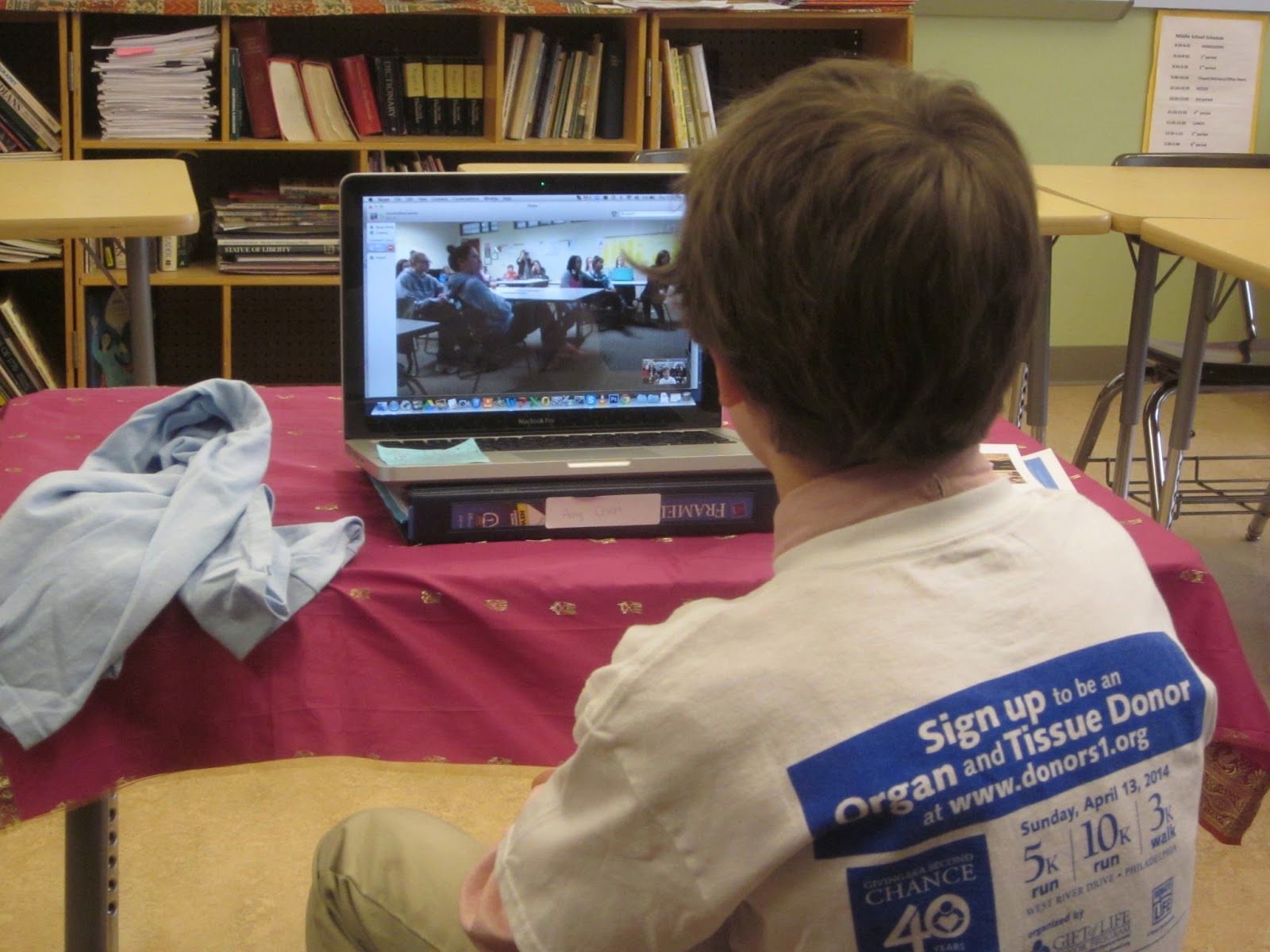
Aiden advocated for the Gift of Life Donor Program, educating classmates and adults about the need for organ and tissue donors.  He participated in a 5K Donor Dash and used social media, including a blog.  “I was able to spread my message to people in Africa, Bermuda, and all over the United States.  I realize I may just be a kid, but anyone can make a difference,” said Aiden.
Adam and Emily sang at a senior center, employing their love of music to bring joy to others.  An audience member told Adam, “Son, you made me smile today.”  Adam realized, “It made me feel good to know that by doing something that makes me happy I could affect others as well.”
Matthew knows someone who uses a Seeing-Eye dog, and of course, he knows Einstein, one of our school’s own Seeing-Eye-puppies.  He combined his love of animals with his love for people as he and Mrs. Fran McLaughlin took Einstein to visit residents of a retirement home.  He also taught his peers about the Seeing Eye training process.  In another animal project, Torrie and Paige created a slogan, “Unleash joy with a homemade toy,” as they created hand-made toys for the dogs and cats at the local SPCA. 
Intrepid gardeners Will and Drew taught composting and gardening, impressing their peers with organic lettuce they raised in backyard gardens.  That TCAP project led Will to oversee composting in his household for the next three years.  He was quite proud that it reduced the family's trash output to one bag a week.  

Grace researched the issue of e-waste.  “Electronic waste is bad for the environment because when e-waste is put in landfills or incinerators it releases certain toxins into the air” and wastes useful materials.  She learned about our school’s e-waste policies and taught her classmates about community recycling programs.  “I care about this problem because of my passion for technology and my love of the Earth,” reflected Grace on her project choice.  

Other environmentally focused projects included Justin’s work to monitor water quality in fishing streams and the efforts of Natalie and Katie to educate neighbors and peers about the importance of protecting bats by building bat houses.  “Bats are important to the world,” states Katie.  “They eat pounds and pounds of mosquitoes and other insects.”  Natalie concurs, “This prevents some diseases from spreading to humans.”

Projects ranged from teaching how to save a life in an emergency, to how to prevent bullying, to how to train a dog, to how to adopt an animal from a shelter, to how many calories are in chicken patty lunch—and why it matters.

A new twist: middle school students teach college students

At NCSS in 2014, I met Dr. Elizabeth O. Crawford, an education professor at University of North Carolina Wilmington.  We began a partnership that involved my middle school "veterans" of TCAPs teaching her pre-service elementary education teachers how to conduct TCAPs themselves.  Through video sessions between our classrooms in Pennsylvania and North Carolina, students shared projects, teaching ideas, and advice.  


(See videos of our teaching sessions below, and read about our efforts and her students' projects in my July 2015 and July 2016 guest post series.)


Educator Sister Joan Magnetti asked, “We overwhelm children with all the suffering and evil in the world, but do we enable them to act?”  The Sixth Grade Think-Care-Act Project does just that. 
--Susan Gelber Cannon
November 2014, November 2016, & November 2017


LINKS TO RESOURCES:  
1. Kids Change the World: Local and Global Think-Care-Act Projects, Workshop HANDOUT with SLIDES: Session 1346, Association for Middle Level Educators [#AMLE2017], Philadelphia, PA, November 2017, Monday, November 6, 2:30 PM

2. CHANGE THE WORLD: SUE CANNON & USHA BALAMORE'S NATIONAL FORUM ON CHARACTER EDUCATION HANDOUT WITH SLIDES: Washington, DC, October 2016

3. CHANGE THE WORLD: SUE CANNON'S NCSS WORKSHOP HANDOUT : Classroom handouts for Nobel Peace Prize Bingo, Human Rights Role Plays, and Think-Care-Act Project directions (including student sample work), as well as slides for #NCSS2014 Session 493.

4. PeaceJam-How to Start video Good 2-minute intro to the process of informed action

5. Do Something: Causes Website  Selection of various arenas in which to take action

6. Susan Cannon's middle school students teach Dr. Elizabeth Crawford's pre-service teaching class how to do Think-Care-Act Projects Video introduces peace education, human rights, and social action concepts, featuring middle school student activists and future teachers collaborating and learning from each other.