By teaching our students to think, care, and act, we empower them to build a peaceful future.


Welcome to Think, Care, Act, where teachers and students can find rationales and resources to infuse required curricula with peace, character, global, and multicultural concepts throughout the year.

To act in a world whose problems seem overwhelming requires being able to use the powers of critical and creative thinking and compassionate and inclusive care. Employing these tools, adults and youth alike can work effectively and conscientiously to solve problems big and small, global and local.

Showing posts with label Think-Care-Act Projects. Show all posts

Saturday, November 4, 2017

KIDS CHANGE THE WORLD: LOCAL & GLOBAL THINK-CARE-ACT PROJECTS (AN UPDATE ON TCAP)


“We overwhelm children with all the suffering and evil in the world, but do we enable them to act?”  

Educator Sister Joan Magnetti

“I learned that you can change the world in small doses, one at a time.” 
Sixth Grade Girl
To act in a world whose problems seem overwhelming requires being able to use the powers of 
critical and creative thinking and compassionate and inclusive care.  Employing these tools, adults and youth alike can act effectively and conscientiously 
to solve problems big and small, global and local.
Susan Gelber Cannon

“Change the world.  Details coming soon.”

At national and international conferences, I introduce teachers to Think-Care-Act Projects, designed to empower students to take informed social action. The workshops help teachers incorporate social-action projects in history classes and school culture.  I invite teachers to include real-world action in their classes at my presentation in Philadelphia at the national Association for Middle Level Educators [AMLE] conference.  Participants learn a manageable Freirean model of social action that incorporates critical and creative thinking, compassionate local and global care, and informed and effective social action.  The resources in this blog enable teachers to help students think, care, and act regarding local and global problems in pragmatic, age-appropriate ways that empower rather than overwhelm them.  
Handouts are linked below. These feature numerous resources to promote critical thinking, compassion, and action and are provided to get kids, teachers, and families started on think-care-act projects.
·               Think-Care-Act Project steps include critically thinking about local and global issues that affect people, animals, and the environment; evaluating personal passions, talents, and signature strengths to select the most cared about issues; formulating and implementing effective action plans with achievable goals; communicating actions taken; and evaluating effectiveness.

Sixth Graders Change the World with Think-Care-Act Projects : An timeline of classroom projects
To make a difference in a world whose problems seem overwhelming requires being able to use the powers of critical and creative thinking and compassionate and inclusive care.  Employing these tools, adults and youth alike can act effectively and conscientiously to solve problems big and small, global and local.  Sixth graders showed they are ready to tackle problems of all sizes with their Think-Care-Act Projects.
Here's how we've done it at my school, The Episcopal Academy.  Just before spring break, sixth grade history teachers pique their students’ curiosity with a seemingly simple homework assignment: “Change the world.  Details coming soon.”
In my classes, via role-plays, games and videos, I introduce students to the Universal Declaration of Human Rights and to such activists as Nobel Peace Prize laureates.  We visit websites like PeaceJam and Roots and Shoots, and I show students photos and brochures of previous Think-Care-Act Projects. 


For several weeks, under their teachers’ guidance, sixth graders think deeply about their unique talents, hobbies, qualities, and values they can employ in changing the world for the better.  Helpfully, we have worked on identifying and using our signature strengths all year, inspired by the work of Martin Seligman and the Values in Action team.
Having considered their signature strengths, they next consider the problems involving people, animals, and the environment that draw them to action.  Many students involve their families in discussions of worthy causes and action.  Some students opt to involve themselves in family causes.  Eventually, students combine their unique skill-sets with their passions for service as they embark on research and social-action projects that culminate with each student making a difference at school and in the community.
In 2004 I had introduced the project to my sixth grade history students calling it the Citizenship Action Project.  Character educator Dr. Usha Balamore, adopted the project for the entire fifth grade at The Shipley School, changing the name in honor of my book title and the steps of the project.  Thus, in 2014 (the ten-year anniversary) our history-class final project at EA became the Think-Care-Act Project or TCAP.  The name stuck, and it now involves our school’s entire sixth grade with the guidance of my fellow history teachers.
Why does a social action project belong in a history class curriculum?  Said a former student, “All year we’ve been studying people who made history.  Finally we get to make history ourselves.”

Making history ourselves
Projects have been as varied as the students themselves.  Students have worked alone and in small groups, researching issues, learning about root causes, contacting organizations active in solutions, taking hands-on action, and preparing to teach their peers about their topics.  Introduced in March, the culminating event is the Think-Care-Act Fair held in Middle School in May.  At this event, sixth grade “experts” teach Lower and Middle School visitors, teachers, and family members how they, too, can change the world.  
Melanie and Skylar researched the problems of poverty in the local community.  Their research led them to an organization called Our Closet that provides clothing to people who cannot afford to buy clothing.  “I cared about Our Closet because it allows people to look nice for jobs and to support their families,” says Melanie.  She and Skylar spoke to twelve Lower School classes about the organization, collected bags of clothing at school, and collected a truckload of clothing at an off-campus site.  “I care personally about this problem because I realized how many clothes I have and how little others have,” Skylar reflected.
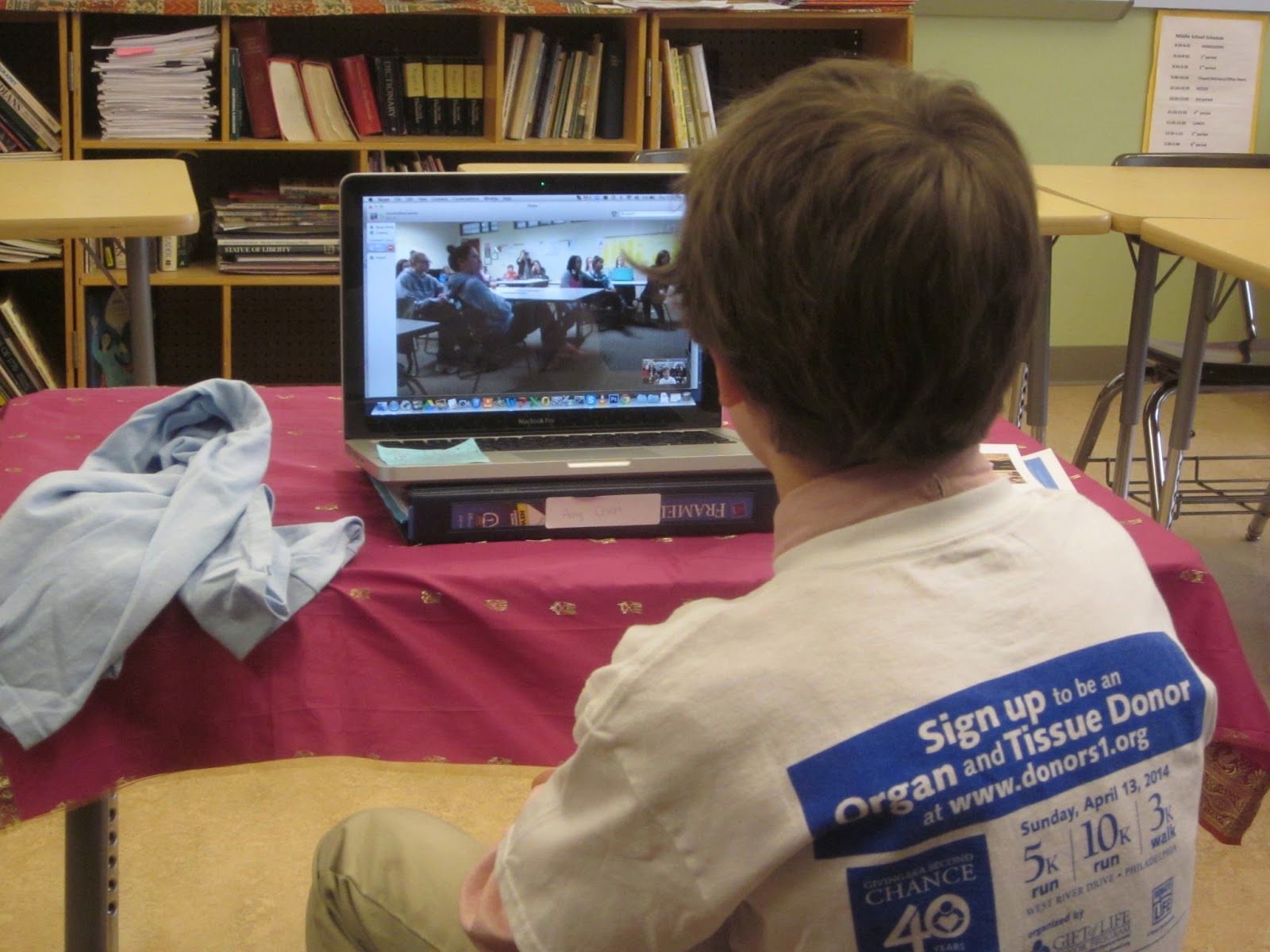
Aiden advocated for the Gift of Life Donor Program, educating classmates and adults about the need for organ and tissue donors.  He participated in a 5K Donor Dash and used social media, including a blog.  “I was able to spread my message to people in Africa, Bermuda, and all over the United States.  I realize I may just be a kid, but anyone can make a difference,” said Aiden.
Adam and Emily sang at a senior center, employing their love of music to bring joy to others.  An audience member told Adam, “Son, you made me smile today.”  Adam realized, “It made me feel good to know that by doing something that makes me happy I could affect others as well.”
Matthew knows someone who uses a Seeing-Eye dog, and of course, he knows Einstein, one of our school’s own Seeing-Eye-puppies.  He combined his love of animals with his love for people as he and Mrs. Fran McLaughlin took Einstein to visit residents of a retirement home.  He also taught his peers about the Seeing Eye training process.  In another animal project, Torrie and Paige created a slogan, “Unleash joy with a homemade toy,” as they created hand-made toys for the dogs and cats at the local SPCA. 
Intrepid gardeners Will and Drew taught composting and gardening, impressing their peers with organic lettuce they raised in backyard gardens.  That TCAP project led Will to oversee composting in his household for the next three years.  He was quite proud that it reduced the family's trash output to one bag a week.  

Grace researched the issue of e-waste.  “Electronic waste is bad for the environment because when e-waste is put in landfills or incinerators it releases certain toxins into the air” and wastes useful materials.  She learned about our school’s e-waste policies and taught her classmates about community recycling programs.  “I care about this problem because of my passion for technology and my love of the Earth,” reflected Grace on her project choice.  

Other environmentally focused projects included Justin’s work to monitor water quality in fishing streams and the efforts of Natalie and Katie to educate neighbors and peers about the importance of protecting bats by building bat houses.  “Bats are important to the world,” states Katie.  “They eat pounds and pounds of mosquitoes and other insects.”  Natalie concurs, “This prevents some diseases from spreading to humans.”

Projects ranged from teaching how to save a life in an emergency, to how to prevent bullying, to how to train a dog, to how to adopt an animal from a shelter, to how many calories are in chicken patty lunch—and why it matters.

A new twist: middle school students teach college students

At NCSS in 2014, I met Dr. Elizabeth O. Crawford, an education professor at University of North Carolina Wilmington.  We began a partnership that involved my middle school "veterans" of TCAPs teaching her pre-service elementary education teachers how to conduct TCAPs themselves.  Through video sessions between our classrooms in Pennsylvania and North Carolina, students shared projects, teaching ideas, and advice.  


(See videos of our teaching sessions below, and read about our efforts and her students' projects in my July 2015 and July 2016 guest post series.)


Educator Sister Joan Magnetti asked, “We overwhelm children with all the suffering and evil in the world, but do we enable them to act?”  The Sixth Grade Think-Care-Act Project does just that. 
--Susan Gelber Cannon
November 2014, November 2016, & November 2017


LINKS TO RESOURCES:  
1. Kids Change the World: Local and Global Think-Care-Act Projects, Workshop HANDOUT with SLIDES: Session 1346, Association for Middle Level Educators [#AMLE2017], Philadelphia, PA, November 2017, Monday, November 6, 2:30 PM

2. CHANGE THE WORLD: SUE CANNON & USHA BALAMORE'S NATIONAL FORUM ON CHARACTER EDUCATION HANDOUT WITH SLIDES: Washington, DC, October 2016

3. CHANGE THE WORLD: SUE CANNON'S NCSS WORKSHOP HANDOUT : Classroom handouts for Nobel Peace Prize Bingo, Human Rights Role Plays, and Think-Care-Act Project directions (including student sample work), as well as slides for #NCSS2014 Session 493.

4. PeaceJam-How to Start video Good 2-minute intro to the process of informed action

5. Do Something: Causes Website  Selection of various arenas in which to take action

6. Susan Cannon's middle school students teach Dr. Elizabeth Crawford's pre-service teaching class how to do Think-Care-Act Projects Video introduces peace education, human rights, and social action concepts, featuring middle school student activists and future teachers collaborating and learning from each other.

Sunday, August 28, 2016

TEACHING EMPATHY: Book Review of UNSELFIE: Why Empathetic Kids Succeed in Our All-About-Me World, by Michele Borba

As we prepare for classroom activities with children and conferences with families, we will find many helpful rationales and resources in Michele Borba's book, Unselfie: Why Empathetic Kids Succeed in Our All-About-Me-World.  Along with this summary, find links to empathy-building activities.  I recommend this book to teachers and families of students of all ages.


“But why should we want our kids to empathize?  For starters, the ability to empathize affects our kids’ future health, wealth, authentic happiness, relationship satisfaction, and ability to bounce back from adversity.  It promotes kindness, prosocial behaviors, and moral courage, and it is an effective antidote to bullying, aggression, prejudice, and racism.  Empathy is also a positive predictor of children’s reading and math test scores and critical thinking skills, prepares kids for the global world, and gives them a job market boost….

“Empathy is core to everything that makes a society civilized, but above all it makes our children better people, and that’s why I’m concerned.  In the past decades, our kids’ capacity to care has plummeted while self-absorption has skyrocketed, and it puts humanity at stake.  Today’s culture values ‘Me’ more than ‘We.’”
(Michele Borba, from the introduction, p. xiv)

Summary:  Readable, anecdotal, and practical, Michele Borba asks families, teachers, and coaches who work with children to counter “selfie society” and help children develop empathy and become “Unselfies.”  Connecting empathy to quality of life, personal achievement, and humanity’s future, Borba organizes her book in three sections, asking us to help children develop empathy, practice empathy, and live empathy by becoming upstanders and changemakers.  This is a good book to recommend to parents and guardians to read, and from which teachers and administrators can share excerpts for discussion or in school newsletters.  As well, teachers will find the book chock full of games, discussion prompts, and classroom fundamentals to lay a foundation of empathy building.

Borba cites numerous and varied studies throughout the book, always pointing to the importance of empathy in children’s achievement and success as well as in their development as compassionate and courageous human beings.  Using the phrase “Empathy Advantage,” she is clearly aiming to make believers out of achievement-oriented parents/guardians and teachers.  She reminds us that empathy can (and must) be cultivated, practiced, taught, and encouraged.

Borba starts by citing studies that identify dropping levels of empathy, increased cruelty to peers, more cheating, and higher incidences of mental health issues in today’s youth.  (See Introduction pages xv-xvi for details.)


In Part One: Developing Empathy, Borba suggests numerous ways to teach emotional literacy, encouraging us to tune in to each other and tune out the distractions of digital devices.   With age-by-age strategies in Chapter 1, she suggests such steps as creating “sacred family times” without digital media use, eating together, reading and discussing books about feelings, and taking time to discuss feelings with both boys and girls.  (See pages 21-24 for details.)  In Chapter 2, Borba discusses ways to help children develop moral identities and ethical codes.  Countering the “self-esteem” building trends, she asks us to avoid nurturing narcissism and instead nurture altruism in our children.  She shares such practical strategies as holding family meetings, identifying family values, creating moral mottos, acting as role models for ethical and caring behavior, and sharing strategies to help children monitor their own behavior: “Grandma Test: Would I do it if my grandma heard about it?” or “3Rs Test: Could it damage my relationships or reputation, or might I regret it later?” (See pages 34-45 for details.)  In Chapter 3, Borba describes practical ways to help children understand the perspectives (and feelings) of others.   Calling this ability to “gateway to empathy,” she invites parents and teachers to ask children to “Do it over,” Role play from the other side, “ and “Freeze and think,” about how their actions have affected others.  Rather than spanking, yelling, shaming, or rewarding children, Borba asks adults to plainly explain why an action is hurtful, to express disappointment in selfish behavior, or help the child/teen recognize how their actions impact others.  This type of “inductive discipline” activates empathy.  (See pages 50-70 for details.)  Finally, in Chapter 4, Borba discusses using literature and movies to develop empathy.  Citing research that suggest digital reading is less conducive to promoting reading enjoyment, she urges children (and families) to share REAL books (especially fiction) to learn about other cultures, others’ feelings, and new perspectives.  Further, she invites us to pose “What if?” and “How Would You Feel?” questions as we read or discuss literature with children and students.  A list of age-by-age strategies to promote moral imagination concludes the chapter and the section.  (See pages 76-92 for details.)


Part Two: Practicing Empathy begins with Chapter 5 and examples of techniques to promote children’s ability to self-regulate their emotions.  The ability to self-regulate allows children to both calm themselves as well as recognize others’ needs.  Yet, in our high-stress society, Borba worries (and research acknowledges) that stress promotes violent and selfish behavior and inhibits compassion.  Thus, she suggests ways parents, teachers, and coaches can model calmness and teach self-control, using mindfulness techniques such as deep breathing, identifying our bodies’ signals, and using positive message “self talk.”  (See pages 98-116 for details.)  In Chapter 6, after citing scientific studies asserting that kindness is catching (and leads to personal happiness), Borba cites many examples of school children practicing daily acts of kindness.  Harvard University’s “Making Caring Common” Initiative has publicized disturbing evidence that students perceive that their parents value achievement over kindness.  To counter this trend, Borba asks us to actively teach kindness and show children how important it is.  Again she asks us to model kindness, and she gives examples of family and classroom kindness “rituals” that go beyond monetary rewards.  Kindness pledges, kindness jars, kindness walls all help children to build kindness into daily actions.  (See pages 125-140 for details.)  Chapter 7 invites us to boost “us” and “we” thinking.  She wants us to build recess into our school schedules and free-play time into our children’s lives to allow children to build collaborative and problem solving skills.  Citing Elliot Aronson’s psychological research, she promotes cooperative learning groups in school as a way to allow children to get to know each other by working together on structured tasks.  She also encourages us to use such activities as Mix It Up Day, family meetings, cooperative games, and youth service groups to enable kids (and families) to work with a variety of people on meaningful tasks.  See pages 152-164 for details.) 


So how to bring empathy into action?  This is the topic of Part Three: Living Empathy.  In Chapter 8, Borba shines a spotlight on kids who stick their necks out and demonstrate moral courage.  She discusses factors that encourage children and adults to be bystanders rather than upstanders: “Powerlessness,” “Vague expectations,” “Peer pressure,” “The diffusion of responsibility,” “Empathy arousal (feeling too bad to help),” and “Weak adult support.”  How can we encourage children to help?  We can expect them to help, set examples ourselves, show them examples of heroic people, stop solving their problems for them, and using baby steps to larger acts of heroism and helpfulness. With pneumonic devices, Michele Borba offers parents, teachers, coaches, and kids steps for such empathetic actions as intervening to stop bullying.  “STANDUP,” for example, reminds kids to Seek Support, Tell a Trusted Adult, Assist the Victim, Negate (rumors, insults) with a Positive View, Design a Detour, Use a Distraction, and Pause and Rethink (See pages 178-182 for details.)  Finally, in Chapter 9, Borba asks us to empower children to become “changemakers.”  Using steps very congenial with our “Think-Care-Act Project” model, Borba suggests we help children see themselves through a “growth Mindset” lens, able to develop empathy and exercise it increasingly effectively.  Next we emphasize effort over results, and suggest practice and evaluation.  (See pages 201-213 for details.)

Classroom/School Applications:

1.    Share articles with families to invite them to be part of the process of teaching empathy.
a.   Harvard’s Making Caring Common Initiative offers a concise four-page list of suggestions for families to use with children to build empathy: http://mcc.gse.harvard.edu/files/gse-mcc/files/empathy.pdf
b.    Share The Atlantic’s article on Denmark’s program to teach empathy in schools: http://www.theatlantic.com/education/archive/2016/08/the-us-empathy-gap/494975/
2.    The book is chock full of practical mini-lessons as well as larger projects.  Try some of the breathing exercises on page 113, for example:
a.    “Buddy Breathing:” Sit back-to-back and try to match breaths while deeply breathing.
b.    “Belly Buddies:” Children recline with stuffed animal or pretty stone on tummy, and feel it go up and down with deep breathing.
c.     “Candles and Flowers:” Child imagines breathing in a flower and blowing out candles. 
3.    Consider undertaking Think-Care-Act Projects in your school by grade level or in your own class.  Detailed rationales, resources, handouts, and directions can be found on my blog: http://thinkcareact.blogspot.jp/2014/11/change-world-local-global-think-care.html
4.    Try some of these classroom activities, described by Character.org: http://character.org/lessons/lesson-plans/

 “Mobilizing children’s moral courage to be Upstanders may be our best hope to stop peer cruelty,” says Michele Borba (p. 181).  It also may be key to the quality of our children’s lives and our development as true human beings.

Susan Gelber Cannon
August 2016


Thursday, July 28, 2016

GUEST POST #5: FIGHTING HUNGER (EA/UNCW THINK-CARE-ACT PROJECT PARTNERSHIP 2016)

Changing the World…. One Project at a Time: Fighting Hunger
 EA/UNCW Think-Care-Act Project Partnership.

Introduction:
Dr. Elizabeth O. Crawford, an education professor at University of North Carolina Wilmington, and Susan Gelber Cannon, a middle school teacher, author, and developer of Think-Care-Act Projects, are pleased to present our second collaborative year of sharing Think-Care-Act-Projects [TCAP].  Our EA/UNCW Think-Care-Act Project Partnership allows Episcopal Academy sixth graders and Dr. Crawford’s senior UNCW pre-service education majors to consider personal qualities and talents, identify passions for social change, and act to change the world for the better.  Through video sessions, my students and those of Dr. Crawford have inspired and encouraged each other to make a difference. 

Below, and for previous four blog posts, you will read future teachers’ guest blogs about their TCAPs, with links for research and teaching suggestions.  Happy reading and thinking, caring, and acting!—Sue Cannon

Fighting Hunger: A Look Into The Problem Of World Hunger
Think-Care-Act Project by Chelsea Anderson and Jenna DeHart
University of North Carolina at Wilmington, May 2016

Food is one of the major necessities needed for life. Without food, individuals do not have the nutrition needed to concentrate and focus, or the energy needed for survival. Without food, there is no living. For our Think-Care-Act Project we researched why there are so many people hungry across the globe and how educators can teach about this world issue to their students and get them to become young solutionaries to this pressing problem.

Causes of Hunger

The primary cause of hunger is poverty. Individuals living in poverty often cannot afford healthy foods or have access to transportation to get to the food. Lacking empowerment and resources to escape it, individuals find it hard to escape poverty (World Food Programme, 2016). In developing farming countries, for example, farmers cannot afford seeds to plant crops to feed their families (World Food Programme, 2016). The hungry usually do not have access to other components of life such as education, water, and land, and therefore the cycle of hunger is not broken easily.

The world has stores of 2.9 trillion pounds of food, enough to feed every individual in all nations twice.  However, there is no explanation of where all of this food is going, considering how many people are hungry (Royte, 2016). In developing countries, much food is lost because there are no sturdy roads, adequate refrigeration, or steady climates to keep the food fresh. In developed nations, however, there is a different story. Restaurants serve too much food, individuals forget about leftovers in the refrigerator, and food is being thrown out before the expiration date (Royte, 2016).  Food is wasted in spite of the fact that hunger exists.

Teaching about World Hunger

The first action step that should be taken when it comes to addressing world hunger is education. Students, especially, do not realize how big of an issue hunger is unless it impacts them directly or they are told about it. Students will develop a personal interest in the problem if they become passionate about becoming solutionaries toward the issue. It is important to show students the issue at hand either through personal narratives, children’s literature, web resources, or videos. It is also necessary to show students other children who are taking action on the same problem and becoming a solutionary. This will inspire students to see that age has nothing to do with being able to take a stand on an issue. A lesson on this issue should include having students come up with solutions on what they and their families can do to reduce the number of hungry people, starting in their own communities.

Our Action Plans

Working as a pair, we focused our actions differently. Jenna placed more of an emphasis on education. She taught a lesson to third grade students to show them that hunger is a prominent issue affecting individuals and families around the world and locally. Jenna and the class then came up with solutions that they can do individually or with their families to help with the problem. 


The solutions varied from hosting a food drive, to donating canned food, to donating money, or to volunteering with their families at a soup kitchen, food bank, or Salvation Army. For example, a student and his family volunteered at a soup kitchen to serve meals to families in need.  Jenna also collected canned food from friends and family to deliver to the Second Harvest Bank and donated money to the World Food Programme to help with funding education and various programs locally and globally so hungry individuals can escape poverty and have a better life.


Chelsea’s approach was geared towards supporting global organizations that focus on finding innovative solutions to the problem of world hunger. She directed a youth group with middle and high school youth in Morganton, North Carolina in their participation in World Vision’s “30-Hour Famine.” Chelsea helped organize and promote the youth group’s participation in the program and help them receive sponsors as they fasted for thirty hours and worked together by participating in team-building games and simulations of how people must survive when they must support themselves when they are hungry and living in impoverished areas. She was able to Skype in with the youth group throughout the thirty hours to support and encourage them for their participation. 

Chelsea noted how many of the students shared how excited they were to be able to make an impact on the world through their participation.  They now had a greater outlook on what some people have to deal with and do to survive in the world. She shared that the youth group raised over $400 to support World Vision and also donated over 100 pounds of food to their local soup kitchen.

Teaching Resources and References

Information on Think-Care-Act Projects:

Seven great lessons to teach kids about hunger and food insecurity. (2013, September 10). Retrieved from http://kidworldcitizen.org/2013/09/09/great-lessons-teach-kids-about-hunger-food-insecurity/

Milway, K. S., & Fernandes, E. (2008). one hen: how one small loan made a big
         difference. Toronto: Kids Can Press.

Suggested Books. (n.d.). Retrieved from http://www.kidscanmakeadifference.org/program-description

Top 10 books to help kids understand hunger - Lasso the Moon. (2012, September 13).
Retrieved from Royte, E. (2016, March 01). http://letslassothemoon.com/2012/09/13/book-on-hunger/

How 'ugly' fruits and vegetables can help solve world hunger.

10 ways to stop world hunger. (2013, October 02). Retrieved from

What causes hunger? | WFP | United Nations World Food Programme - Fighting Hunger Worldwide. (2016). Retrieved from https://www.wfp.org/hunger/causes