By teaching our students to think, care, and act, we empower them to build a peaceful future.


Welcome to Think, Care, Act, where teachers and students can find rationales and resources to infuse required curricula with peace, character, global, and multicultural concepts throughout the year.

To act in a world whose problems seem overwhelming requires being able to use the powers of critical and creative thinking and compassionate and inclusive care. Employing these tools, adults and youth alike can work effectively and conscientiously to solve problems big and small, global and local.

Thursday, September 3, 2026

Resources for Reading and Teaching about Poet Mary Oliver


Who am I that I

read Mary Oliver and think

I’m a writer too?


I photograph and write haikus as I walk around my yard, the woods, or the lake. Often I do this after I’ve soaked in Mary Oliver’s poetry. I’m still pondering her use of the word “iceberg,” in “When Death Comes.” I might have used “ice pick.” I know there is a reason, having read her Poetry Handbook. 

The August 2026 release of the PBS American Masters Documentary about Mary Oliver, Saved by the Beauty of the World, prompts me to post these resources for those who love the sound of her voice, who bathe in the beauty of her words.


PBS: American Masters: Mary Oliver: Saved by the Beauty of the World: (1:22:25 video) https://www.pbs.org/wnet/americanmasters/mary-oliver-documentary/37967/


Mary Oliver’s Official Webpage features bio, books, and more: https://maryoliver.com/


Mary Oliver reads from A Thousand Mornings at 92nd Street Y: (41 minute video) https://www.youtube.com/watch?v=zsr3ZZzH-MA


Mary Oliver in conversation with Coleman Barks, August 2001 (33 minute video): https://vimeo.com/11367099

A tribute to Mary Oliver at 92nd Street Y: (1 hour, 6 minute video): https://www.youtube.com/watch?v=kSixhSzkZDc


Krista Tippett’s On Being audio Interview with Mary Oliver: “I got saved by the beauty of the world,” (Original air date February 5, 2015): edited and unedited versions available, with transcripts: https://onbeing.org/programs/mary-oliver-i-got-saved-by-the-beauty-of-the-world/


Maria Shriver’s interview with Mary Oliver, referenced in the documentary, is available here in print form: https://www.oprah.com/entertainment/Maria-Shriver-Interviews-Poet-Mary-Oliver/3 


-Susan Gelber Cannon, September 3, 2026
https://www.instagram.com/suecannonreflects/ 


Tuesday, June 23, 2026

Love and a Payphone: Calling Cousin Bob in the Afterlife


At a women’s gathering, my friend Anna offered a writing prompt: “Write a letter to an ancestor.”
Having just come across a broken pay phone, I chose my long-dead cousin Bob for reasons I'll explain.
 
This week, Bob’s wife Christine died after a long life of accomplishment and struggle, joy, and laughter.
It will take me awhile to write to Christine.
Meanwhile, here is my conversation with cousin Bob, prompted by a love and a pay phone.
 

March 12, 2026

I want to talk to my cousin Bob, so I hold the stripped Bell wires to my ear at the defunct Bi-lo payphone and connect with him—for free—in the afterlife. As always, his voice is warm and soft.

Cousin Bob broke rules and norms. Almost disowned by his parents for marrying a non-Jewish divorcee with two kids (three strikes, you’re out), he was my role model for rebellion. 


The first time I visited Bob and Christine on Long Island in 1968, I was a highschooler. Their home was full of paintings, pottery, LPs, and books. Their table was crowded with intellectual friends who treated me like one of them. Amazingly I could speak and be heard with interest. Picasso, Vietnam, clay, and Nina Simone became part of my reality.

By day, Christine and I worked on her pottery. Afternoons when he returned from teaching college history, Bob and I took outings to the local payphone to rip off Ma Bell. 


Do you remember Ma Bell? Do you remember pay phones? A black plastic receiver, a rotary dial, and a metal coin box mounted in a booth with clear glass folding doors connected you to the world, and you only needed a quarter. The problem was the monopoly the Bell Telephone Company held over the phone network. We were about to disrupt that—with a quarter, sticky tape, and a tape recorder.

We giggled our way into the phone booth, squeezed the doors shut, and taped the quarter to a long strand. Dropping the coin into the slot, we’d await the electronic ding-ding that indicated the call could begin. We’d pull out the quarter and rotary dial a co-conspirator—usually Bob’s wife Christine. Sometimes we’d call my unsuspecting parents. We graduated to tape recorder, recording the signal, replaying it, and making free phone calls to anyone we wanted. 

I still laugh about these excursions. 


Today, at the defunct Bilo in Black Mountain, NC, when I discovered the stripped wires hanging off the receiverless payphone outside, I called Bob in the afterlife. It was a free wireless call. He was pleased.

So, what were you teaching me, Bob—besides how to have fun at corporate expense? 

“How to rebel,” he replied gently. “How to live on your terms, how to build your own life in a world of opposition, how to love, how to build a community, how to build family, how to have fun.” 

Bob died young and suddenly, on the farm in West Virginia where he and Christine created a community hub for underprivileged Lincoln County youth and a home for their growing family. I visited through my college years and young adulthood. 


Bob and Christine were role models and friends as my husband Kadir and I created a commune in Kentucky, built a mud hut, lived off the grid, and battled Ashland Oil Company. That’s a story for another day.

Love, community, family, kindness, rebellion, generosity, joy. These are the enduring messages in my conversations with Bob--and now Christine--in life and in the afterlife. Peace and blessings be upon them. 

-Susan Gelber Cannon, June 23, 2026


Monday, November 25, 2024

BE THANKFUL AND BUILD PEACE EVERY DAY: THE HAUDENOSAUNEE THANKSGIVING ADDRESS

The words of The Haudenosaunee Thanksgiving Address are gentle, inspiring, inclusive, and loving. They remind us to be thankful and peaceful every day. 

The words of “The Thanksgiving Address: the Words that Come Before All Else” in gatherings of members of the Haudenosaunee people, including the Onondaga, Iroquois, Mohawk, Oneida, Cayuga, and Seneca, open our eyes and hearts to everything around us. 


The Haudenosaunee people give thanks every day, not just on Thanksgiving Day


1. This lovely 9-minute video version of The Thanksgiving Address, or “The Words that Come Before All Else,” was recorded by Ina BarrĂ³n with video produced by Sagehorse, Inc., and is featured on the Peace Alliance website.
 (Skip the commercials in all videos.) https://youtu.be/SfeL2VqL2VQ?si=1SAeRmGW0sxAsESM


2. Learn the background in this 4-minute Q & A video with representatives from the Onondaga Nation: Whatwenineh – elder Frieda Jacques (Turtle Clan) and student Kateri - Riley Thornton (Snipe Clan): https://www.youtube.com/watch?v=swJs2cGNwIU   


This video explains: “The Thanksgiving Address (the Ohen:ton Karihwatehkwen) is the central invocation for the Haudenosaunee (also known as the Iroquois Confederacy or Six Nations — Mohawk, Oneida, Cayuga, Onondaga, Seneca, and Tuscarora). 

It reflects their relationship of giving thanks for life and the world around them. This video, filmed on location at the Onondaga Nation School in Onondaga Nation, focuses on the purpose and uses of the Haudenosaunee Thanksgiving Address. (This video is part of the New York State Education Department Curriculum.)”


3. Matika Wilbur’s Project 562 presents youth from upstate New York’s Akwesasne, a Mohawk Nation, speaking a short (2-minute) version of the Address in Akwesasne.


The engaging high school students giggle and smile as they speak the Ohen:ton Karihwatehkwen, understood as the “Words Before All Else,” “The Greetings To The Natural World,” or “The Opening Address.”  https://www.project562.com/blog/363283-a-real-thanksgiving-address-the-words-that-come-before-all-else 

4. This PDF version, from the National Museum of the American Indian would make a wonderful classroom illustration project or classroom or family read-aloud: https://americanindian.si.edu/environment/pdf/01_02_Thanksgiving_Address.pdf


5. To broaden students’ understanding of the Mohawk people today and to think about ecological concerns of the Mohawk people in upstate NY, show this 5-minute video that starts with Akwesasne Freedom School’s teacher Maxine Cole’s clear explanation of the daily nature of the Thanksgiving Address and moves to the role of the ash tree in Mohawk culture. This page is from the National Museum of the American Indian, and has many more teaching resources, including interactive quizzes and more.  https://americanindian.si.edu/environment/akwesasne/People.cshtml


6. The Haudenosaunee Guide for Educators, produced by the National Museum of the American Indian, introduces many concepts, including the Haudenosaunee’s Great Law of Peace, which influenced Benjamin Franklin and other creators of the United States Constitution. https://americanindian.si.edu/sites/1/files/pdf/education/HaudenosauneeGuide.pdf


7. Learn more about the peacebuilding mission of The Peace Alliance, working for peace education, enhancing personal peace practice, to pass HR 1111 to create a U.S. Department of Peacebuilding, and other social justice concerns. https://peacealliance.org


May we be thankful and build peace… every day.


Susan Gelber Cannon, November 2024

Tuesday, July 16, 2024

Oiling a Dead Man's Boat

“Believe me, my young friend, there is nothing - absolutely nothing - half so much worth doing as simply messing about in boats.” 
–Kenneth Grahame, The Wind in the Willows


For our 40th anniversary in 2012, Kadir and I bought each other boats we could easily lift: Hornbeck’s fourteen-foot New Trick. These were the latest of Pete Hornbeck’s ultralight pack canoes, light enough to carry across trails between glistening glacial lakes in the Adirondacks. Crafted of a mix of Kevlar and carbon fiber, New Tricks are spare, slim, and canoe-like, paddled solo with a double blade, and weighing just under 25 pounds. The last few ounces were Hornbeck’s concession to beauty over lightness: the decks and gunnels—top rails—are rich cherry wood.


Kadir bought the second New Trick Pete’s crew made in October 2012. He asked for an extra layer of carbon fiber so he could muck over logs and beaver dams. Paddling was a pleasure, but the cherry gunnels needed care, and Kadir didn’t oil his gunnels. Until I propped it on logs, he stored his boat with gunnels and decks resting directly on the damp earth for weeks at a time until paddling season. 


When I remembered, I oiled the gunnels on his boat, then my boat, purchased six months later. The cherry rails gleamed. Eventually, we moved to western North Carolina, where the lakes are manmade, and Alzheimer’s gradually took Kadir’s mind and body. Kadir was unable to paddle, and there was little time for paddling for me. Our boats rested on racks until Kadir died in 2023. 


The first time I paddled after his passing, it was annoyingly windy on Lake Julian. Rollers marched toward me in steady formation—paddling conditions Kadir loved, and I hate. Gritting my teeth, I aimed my Hornbeck’s bow into the wind and knuckled down for my crossing. “It’s just one damn wave after another,” I observed. I was talking about grief as well as water. 


Cherry wood looks warm and lovely when cared for, and I oiled the gunnels of both boats each spring, eventually using the last drop of the aromatic tung oil mixture Pete Hornbeck gave us when we purchased our boats. But Kadir’s gunnels were separating from the rotting decks at his bow and stern. No one paddled the boat, so I needn’t have worried about it, but it bothered me. We’d paddled these beautiful crafts miles together in the Adirondacks. They’re full of memories.


I called Hornbeck Boats. Pete Hornbeck had died in 2020, so I told Josh and Andy about Kadir’s boat. “Sand the decks. Try longer screws. Hand tighten everything,” they suggested. I did. It worked. Andy added, “Oiling can do wonders.”


Rooting around in Kadir’s many crates of art supplies, I dug out a can of tung oil. I found an old t-shirt of Kadir’s and cut a square from the soft, purple sleeve. Dip. Wipe. Dip. Wipe. “I’m oiling a dead man’s boat,” I chuckled to no one. 


There is something satisfying about how good Kadir’s boat looks. And yes, purists spell the top rail of a boat “gunwale,” but Kadir would have spelled it gunnel. It makes more sense.


-Susan Gelber Cannon, July 2024  


Tuesday, January 17, 2023

Climate Change Comics-Teaching for Climate Action

Overcoming Overwhelm

Recently, a dear friend reflected, "I feel overwhelmed by this climate change business. I'm 85, a veteran of the Civil Rights struggles and all sorts of peace movements. But this climate change.... I feel helpless to do anything about it. The scientific complexity! My inability to understand the science is one reason for my being overwhelmed. The second reason is the global scale. ” 

Many feel overwhelmed. These feelings are normal. In my experience, action is the best way to overcome overwhelm.

NPR: Climate Change Comics

NPR has created a teaching tool about climate change action for late elementary through high school students. Listen to the NPR story at this link to "Coping with climate change: Advice for kids — from kids."


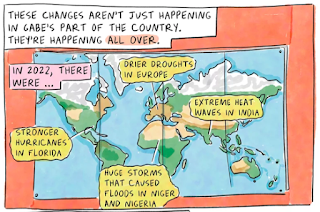
Click here for a link to a scrollable or printable COMIC about creating a climate change community and doing climate action. The comic tells how climate change affects two students in Colorado. It includes advice from a psychologist and depicts the students' struggles and effective climate actions. 

A related resource from NPR is "Climate change is here. These 6 tips can help you talk to kids about it."

Think-Care-Act Projects

My sixth graders conducted similar action projects (on a variety of issues) as depicted in the comic. For a step-by-step guide to doing action projects in your classes, click here.


"I learned that you can change the world in small doses, one at a time."

Sixth Grader


To act in a world whose problems seem overwhelming requires being able to use the powers of critical and creative thinking and compassionate and inclusive care. Employing these tools, adults and youth alike can act effectively and conscientiously to solve problems big and small, global and local."

Susan Gelber Cannon


Tuesday, March 24, 2020

Parenting in Pandemic: Caring & Curiosity with Covid-19

During the Covid19 pandemic, I’ve been “sheltering in place,” thinking of ways to be helpful without risking my health or the health of others. I’ve been sharing ideas for pandemic exercise and fun with family members who are home with kids of various ages. It’s time to share them with you, my blog community! This blog begins with links to psychologists’ advice to those who are caring for children, adolescents, and college students. It continues with exercise links and activity links for young and old. This blog ends in nature and silliness ("pandemonium?").

 Radio Times Podcast: Parenting During the Pandemic
Let’s start with some sanity and guidance for parents and guardians, provided by Marti Moss-Coane and guests on WHYY, Philadelphia’s public radio station. This Radio Times broadcast has great advice for “parenting during the pandemic.”

“Families are under an incredible amount of stress right now. They are of course worried about COVID-19 but many parents are also worried about their jobs, about paying the bills, and about putting food on the table. And on top of all that, schools are closed and parents are caring for their kids around the clock and even trying to homeschool them. This hour, we’ll talk with psychologist TINA BRYSON about the strain families are feeling and healthy ways they can try to cope. We’ll also hear from IMANI PERRY, author of Breathe: A Letter to My Sons, about how she’s spending time at home with her two teenagers. But first, we start off looking at how Philadelphia’s school students are doing and how the district is trying to meet their needs. Philadelphia School District Superintendent WILLIAM HITE joins us to talk about the support they are providing their families.”  See details below.

How are school districts dealing?
You may find the initial interview with Dr. James Hite, superintendent of Philly schools interesting. He deals with inequities among neighborhoods, the differing burdens on families, and School District resources.

Advice for Parents, Guardians, Caregivers: Dr. Tina Bryson
At 14:00, find Dr. Tina Bryson’s practical and soothing advice for parents during this challenging time.
·      PODCAST LINK


“We can’t bubble wrap our children:”
Dr. Bryson’s overarching message is to be emotionally present for our children, despite our present concerns about health, finances, and security and despite our personal flaws and limitations.  Remember, she says, “We set the emotional tone for our children….We cannot bubble-wrap our children and protect them from everything, but our job isn’t to fix everything, but to walk with our children through it.”  Don’t over-listen to the news, she suggests, thus making our kids swim in it with us. Instead, we can help them process their emotions by helping them “name it to tame it.”
·      See Tina Bryson’s webpage for more resources. https://www.tinabryson.com/#home-page


Dr. Imani Perry: What is our “mutual destiny?”
Introduced at 32 minutes into the podcast, Dr. Imani Perry suggests, “Kids all over the world are experiencing this, so trying to figure out how to usher them through this is much more important (than the academic load). Use music, dancing, jokes, she encourages, as her grandmother did during another dangerous time of Jim Crow. “Find small pleasure every day and relish them.”  Both guests encourage us to raise ethical questions with older kids, in hopes they will embrace our “mutual destiny” to make a better world once we get through this crisis.
·      Dr. Imani Perry’s video interview with Krista Tippett at Chautauqua Institute is here: https://www.c-span.org/video/?463088-2/breathe

·      Dr. William Hite and Philadelphia School District resources are here: https://www.philasd.org

Move it or lose it?
Some of you have active children and/or you need a good workout yourself. Check out these daily aerobic exercise classes to get your heart rate up: Exercise with Joe is amazing! (Not for the faint hearted!)  Or, try something meditative and invigorating, like tai chi or yoga. See resources below.

P. E. with JOE!
Can't beat his enthusiasm! On his YouTube Channel (Body Coach TV) Joe shares a new 30-minute YouTube class for kids daily. Scroll past his first talky intro. Tune in for daily workouts. Kids all over the world are participating, and he announces their locations with joy.

Short Workouts from NYTimes:
Here is the link for 6 and 9 minute workouts:


Try Tai Chi!
Not into aerobics? I do tai chi every day, and I am trying to learn the Eight Brocades, slow and meditative, Qigong exercises.  


These “smooth, silken movements” are beautifully explained and led by Mimi Kuo-Deemer in an 18-minute video: https://www.youtube.com/watch?v=3K-0JpiJu-o


Sit in your chair for Yoga!
·      Here is a 10-minute chair yoga routine with good explanations: https://www.verywellfit.com/chair-yoga-poses-3567189


Lower your expectations! There are NUMEROUS academic resources available online for children of all ages. Perhaps your child’s school has assigned a long list of activities. Remember the wise words of Dr. Bryson: “Now is not the time when you have to win the best parent of the year award… lower our expectations.” And don’t forget Dr. Perry’s advice “to find the small pleasures every day and relish them,”

The activities below can be fun for various ages of children.

Scholastic has provided various grade levels with videos and activities for pre-school thru grade-school. Remember, for beginning readers go down a grade level at least! Browse around, choose a video to watch together (I like the bunnies), then try a short activity.

Travel and Leisure Magazine has provided a link to virtually tour twelve art museums. Awesome. Follow with drawing or painting with kids! Want a geography or math lesson? Plan an itinerary to visit one of these museums on day.


We got STEM: These 18 Craft Ideas for Kids from Smart Schoolhouse are so cool! They include making giant bubble mix, microwaving soap... and crafting a geodesic dome! You likely have the materials at home. Unfortunately, you must scroll through numerous ads.


Play with beans, egg cartons, and your imagination or read with Grandma!
I video with my grandson while he shows me the cool activities his mom “cooks up” each day. They are using colorful beads, but you can also try dried beans or noodles. I’m so grateful they video-visit with me. I reciprocate by reading a story to my grandchildren to give their parents a few minutes of rest. Calvin and Hobbes are the current favorites. Do you have some elders who’d enjoy a video visit, card, or call? 


Nature heals us in mind, body, and spirit.
Some of us are lucky enough to be able to go outside. Some of us cannot. I took photos on a nature walk and sent them to my grandchildren with a scavenger hunt list of items to spot. Maybe they will draw some of the plants or make their own rock tower and play “I spy!”  No nature nearby? Take my scavenger hunt nature walk with your child!

“Let's go on a spring nature walk! Who can find flowers? Two are Bloodroot and Violet. Can you find some cool rocks? Can you find some fungi that looks like turkey tails? How about a bunny tail? Can you find prickly leaves? How about a tree tunnel or red berries--NO EATING! Can you find something that looks like a tiny pine tree? It's really a moss! How about Usnea Lichen? I think it looks like a scratchy beard! Can you find a plant with a square stem? That means it’s part of the mint family. Do you have any mint in your house? Can you find a flower with stars inside? What else can you find on our nature walk! What can you find looking out your window or near where you live?

PANDEMONIUM: Do something silly and fun.
Bang some pots and pans with your neighbors, or do a "social distancing drum circle" like we did with our neighbors. The kids danced, the dogs barked, passersby honked, and we had fun drumming away our Covid-19 concerns. 

May we all find and provide comfort with each other, through families, friends, and members of our local and global communities. Stay well and savor our time together.
 3-24-20 Susan Gelber Cannon