By teaching our students to think, care, and act, we empower them to build a peaceful future.


Welcome to Think, Care, Act, where teachers and students can find rationales and resources to infuse required curricula with peace, character, global, and multicultural concepts throughout the year.

To act in a world whose problems seem overwhelming requires being able to use the powers of critical and creative thinking and compassionate and inclusive care. Employing these tools, adults and youth alike can work effectively and conscientiously to solve problems big and small, global and local.

Showing posts with label Episcopal Academy. Show all posts

Thursday, July 28, 2016

GUEST POST #5: FIGHTING HUNGER (EA/UNCW THINK-CARE-ACT PROJECT PARTNERSHIP 2016)

Changing the World…. One Project at a Time: Fighting Hunger
 EA/UNCW Think-Care-Act Project Partnership.

Introduction:
Dr. Elizabeth O. Crawford, an education professor at University of North Carolina Wilmington, and Susan Gelber Cannon, a middle school teacher, author, and developer of Think-Care-Act Projects, are pleased to present our second collaborative year of sharing Think-Care-Act-Projects [TCAP].  Our EA/UNCW Think-Care-Act Project Partnership allows Episcopal Academy sixth graders and Dr. Crawford’s senior UNCW pre-service education majors to consider personal qualities and talents, identify passions for social change, and act to change the world for the better.  Through video sessions, my students and those of Dr. Crawford have inspired and encouraged each other to make a difference. 

Below, and for previous four blog posts, you will read future teachers’ guest blogs about their TCAPs, with links for research and teaching suggestions.  Happy reading and thinking, caring, and acting!—Sue Cannon

Fighting Hunger: A Look Into The Problem Of World Hunger
Think-Care-Act Project by Chelsea Anderson and Jenna DeHart
University of North Carolina at Wilmington, May 2016

Food is one of the major necessities needed for life. Without food, individuals do not have the nutrition needed to concentrate and focus, or the energy needed for survival. Without food, there is no living. For our Think-Care-Act Project we researched why there are so many people hungry across the globe and how educators can teach about this world issue to their students and get them to become young solutionaries to this pressing problem.

Causes of Hunger

The primary cause of hunger is poverty. Individuals living in poverty often cannot afford healthy foods or have access to transportation to get to the food. Lacking empowerment and resources to escape it, individuals find it hard to escape poverty (World Food Programme, 2016). In developing farming countries, for example, farmers cannot afford seeds to plant crops to feed their families (World Food Programme, 2016). The hungry usually do not have access to other components of life such as education, water, and land, and therefore the cycle of hunger is not broken easily.

The world has stores of 2.9 trillion pounds of food, enough to feed every individual in all nations twice.  However, there is no explanation of where all of this food is going, considering how many people are hungry (Royte, 2016). In developing countries, much food is lost because there are no sturdy roads, adequate refrigeration, or steady climates to keep the food fresh. In developed nations, however, there is a different story. Restaurants serve too much food, individuals forget about leftovers in the refrigerator, and food is being thrown out before the expiration date (Royte, 2016).  Food is wasted in spite of the fact that hunger exists.

Teaching about World Hunger

The first action step that should be taken when it comes to addressing world hunger is education. Students, especially, do not realize how big of an issue hunger is unless it impacts them directly or they are told about it. Students will develop a personal interest in the problem if they become passionate about becoming solutionaries toward the issue. It is important to show students the issue at hand either through personal narratives, children’s literature, web resources, or videos. It is also necessary to show students other children who are taking action on the same problem and becoming a solutionary. This will inspire students to see that age has nothing to do with being able to take a stand on an issue. A lesson on this issue should include having students come up with solutions on what they and their families can do to reduce the number of hungry people, starting in their own communities.

Our Action Plans

Working as a pair, we focused our actions differently. Jenna placed more of an emphasis on education. She taught a lesson to third grade students to show them that hunger is a prominent issue affecting individuals and families around the world and locally. Jenna and the class then came up with solutions that they can do individually or with their families to help with the problem. 


The solutions varied from hosting a food drive, to donating canned food, to donating money, or to volunteering with their families at a soup kitchen, food bank, or Salvation Army. For example, a student and his family volunteered at a soup kitchen to serve meals to families in need.  Jenna also collected canned food from friends and family to deliver to the Second Harvest Bank and donated money to the World Food Programme to help with funding education and various programs locally and globally so hungry individuals can escape poverty and have a better life.


Chelsea’s approach was geared towards supporting global organizations that focus on finding innovative solutions to the problem of world hunger. She directed a youth group with middle and high school youth in Morganton, North Carolina in their participation in World Vision’s “30-Hour Famine.” Chelsea helped organize and promote the youth group’s participation in the program and help them receive sponsors as they fasted for thirty hours and worked together by participating in team-building games and simulations of how people must survive when they must support themselves when they are hungry and living in impoverished areas. She was able to Skype in with the youth group throughout the thirty hours to support and encourage them for their participation. 

Chelsea noted how many of the students shared how excited they were to be able to make an impact on the world through their participation.  They now had a greater outlook on what some people have to deal with and do to survive in the world. She shared that the youth group raised over $400 to support World Vision and also donated over 100 pounds of food to their local soup kitchen.

Teaching Resources and References

Information on Think-Care-Act Projects:

Seven great lessons to teach kids about hunger and food insecurity. (2013, September 10). Retrieved from http://kidworldcitizen.org/2013/09/09/great-lessons-teach-kids-about-hunger-food-insecurity/

Milway, K. S., & Fernandes, E. (2008). one hen: how one small loan made a big
         difference. Toronto: Kids Can Press.

Suggested Books. (n.d.). Retrieved from http://www.kidscanmakeadifference.org/program-description

Top 10 books to help kids understand hunger - Lasso the Moon. (2012, September 13).
Retrieved from Royte, E. (2016, March 01). http://letslassothemoon.com/2012/09/13/book-on-hunger/

How 'ugly' fruits and vegetables can help solve world hunger.

10 ways to stop world hunger. (2013, October 02). Retrieved from

What causes hunger? | WFP | United Nations World Food Programme - Fighting Hunger Worldwide. (2016). Retrieved from https://www.wfp.org/hunger/causes


GUEST POST #1: HONEYBEES & ELEPHANTS AS KEYSTONE SPECIES (EA/UNCW THINK-CARE-ACT PROJECT PARTNERSHIP-2016)

Changing the World…. One Project at a Time: Honeybees & Elephants
 EA/UNCW Think-Care-Act Project Partnership.
Introduction:
Dr. Elizabeth O. Crawford, an education professor at University of North Carolina Wilmington, and Susan Gelber Cannon, a middle school teacher, author, and developer of Think-Care-Act Projects, are pleased to present our second collaborative year of sharing Think-Care-Act-Projects [TCAP].  Our EA/UNCW Think-Care-Act Project Partnership allows Episcopal Academy sixth graders and Dr. Crawford’s senior UNCW pre-service education majors to consider personal qualities and talents, identify passions for social change, and act to change the world for the better.  Through video sessions, my students and those of Dr. Crawford have inspired and encouraged each other to make a difference. 

Below, and for the next few blog postings, you will read future teachers’ guest blogs about their TCAPs, with links for research and teaching suggestions. 
Happy reading and thinking, caring, and acting!—Sue Cannon

Honeybees and African Elephants as Keystone Species
Think-Care-Act Project by Brittany Hutton, Destyne Frazier, and Emily Tate
University of North Carolina at Wilmington, May 2016

Both here in our community and all over the world, there are species of animals that are threatened as Earth continually changes. Why should we care about these animals?  Some of these threatened species are keystone species; these are animals that play a huge role in their ecosystems. Some of these animals may not be very big, or very populous.  Yet, keystone species maintain the structure of their communities. The survival of many other species relies on these keystone species.

For our project we looked at honeybees and African elephants, two very important keystone species. While these two animals are quite different from one another, they each play a huge role in their environments. In addition, both of these species are declining in number due to human activities.

Facts about Honeybees

Pollinators are essential for all ecosystems to function, especially the agriculture-dominated ecosystem in which humans live (Spivak, 2013).  Bees—honeybees in particular—are the most important pollinators of fruits, vegetables, and alfalfa.

There are four main causes that we can point to in the decline of honeybees; pesticides, global warming, deforestation, and disease. When honeybees ingest pesticides their memories and navigation skills become scrambled, and in some cases they are “addicted” to nectar that contains pesticides (Carson, 2015, para. 4). One insecticide, a type of pesticide called neonicontinoids begins in the ground and stay in the plant as it grows. These insecticides are lethal enough to kill an insect with one bite of a leaf. Many of the weeds that herbicides kill have flowers which bees need to pollinate and collect nectar from (Spivak, 2013). Neonicontinoids are also found in the pollen and nectar of the plant, and is lethal enough to kill honeybees when they feed (Spivak, 2013). 

Complicating this situation, there is a mite called the Varroa Destructor that causes viruses and compromises immune systems as it sucks the bees’ blood. Because the neurotoxins in the pesticides that bees consume are unhealthy for the bee and often make them confused, the viruses caused by this mite make bees less likely to be able to make it through consuming the unhealthy pollen (Spivak, 2013).

Other conditions also endanger bees.  Changing weather patterns (global warming) are causing honeybees to come out of hibernation early. A cold or rainy spell then comes along that causes them to be unable to go out and collect pollen, and they starve to death in the hive. As industry and development increase, the fields of flowers that honeybees need to collect nectar are being destroyed to make way for new buildings.

Taking Action for Honeybees

In our research, we found that the simplest and most beneficial way to benefit the honeybees is to create a pollinator garden with a water basin for pollinators to drink from. We wrote letters to companies who generously donated many pollinator friendly flowering plants as well as bulbs, soil, and a dish to make a water basin. We chose to plant these plants at Pine Valley Elementary, where we have been interning. The first thing we did was get this project approved with Mrs. Opgrand, the school's principal. Our partnership teachers, who allowed some of the third and fourth graders to help us with the planting, also approved this project. These students had been learning about bees and were very interested in this topic.

The students really enjoyed planting in the garden—even the students who thought they wouldn’t have fun!  We were able to see different sides of the students than we are used to seeing in the classroom.  Students who were typically quiet and unmotivated were taking ownership of their plants and telling stories about gardening with their families at home.  The students who are usually talkative were quiet as they were focused and motivated on their task.  When discussing what we were learning about being outside in a garden during class time, the students realized that they were learning to work together.  They also were learning about gardening, plants, and most importantly helping the bees!

Facts about Elephants


At this time 16,938 species are registered as threatened with extinction (Endangered Species International).  One of those animals is the elephant.  Elephants are a unique, beautiful species that could be facing extinction within the next couple of decades.  This could mean that the next generation might never see an elephant in their lifetime (Wildlife Conservation Society).  These intelligent creatures face many obstacles to survive in their natural habitat.  Humans are in direct competition with elephants for a habitat to live in and are their predators in the wild because of the demand for ivory (SOS Elephants, 2010).  Elephants have become endangered because of humans so it is up to humans to save this creature before it’s too late.  If drastic changes are not made soon then the chances of saving this species will decrease considerably.  

Elephants are the largest land mammal on Earth.  They are recognized by their distinct ears, long trunk, and ivory tusks (World Wildlife Fund).  Elephants live in matriarchal family groups and are also known for their close familial bonds.  The entire herd protects its calves, for example.  Herds, consisting mainly of females, can range in size from 8-100 elephants.  The males leave the family between the ages of 12-15 and live a more solitary lifestyle while females tend to spend their entire lives with their herd (Defenders of Wildlife, 2012). 
 
Elephants are considered a keystone species because they play such a vital part in the African ecosystem.  Animals depend on elephants to pull down trees, dig waterholes, create trails, and produce dung.  Elephant dung is especially important to the African ecosystem because some seeds cannot even germinate without going through an elephant’s system.  Their droppings also disperse seeds around the environment and create fertile soil.  Without elephants, countless species in Africa would be negatively affected (SOS Elephants, 2010).

Taking Action for Elephants

Elephants are a keystone species that needs to be protected.  If citizens care about preventing the extinction of this incredible species, they need to take action.  For communities in proximity to elephant environments, there are local actions to take that differ from the suggestions below for classroom action.  For example, local communities can build healthier human-elephant relationships.  This can be done through monitoring elephants, building fences when needed, and educating citizens in the community.  Another important step is to stop poaching and the sale of ivory.  An estimated ninety-six elephants are killed every day in Africa (Wildlife Conservation Society).  These killings might be prevented by increasing the presence of law enforcement in areas where poaching and the illegal sale of ivory is a problem.  It is also necessary to protect elephant habitats so elephants have the proper space to live and wander freely (World Wildlife Fund).   If enough people care, the elephants will continue to live, instead of becoming extinct.  At this point, humans need to take action if they want future generations to live in a world with elephants, instead of just their tusks.

Using Think-Care-Act Projects in the Classroom

As adults, it is easy to think that one person cannot make a difference.  Society also sends children messages that they should be seen and not heard, that their opinions do not matter, and that they are too young to know better. Think-Care-Act Projects are a great way to remind students that kids can make a difference! As teachers we care about what our students think and care about, and we should empower them to take action. Getting students to think about global issues allows them to realize that the problems that we deal with everyday may have effects on people all over the world. This project is also a great way to get students to express their interests and passions at a young age. By taking action about an issue that they care about, students are engaging in meaningful learning that they will not forget!
        
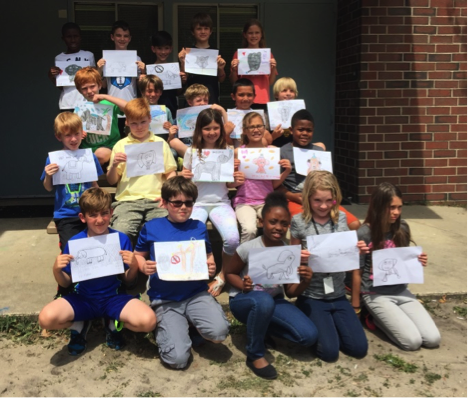
Let’s return to the task of saving the elephants, for example.  Students can make a difference by something as simple as taking an “elphie.”  Taking an elphie is a social media campaign being used by some organizations, like “96elephants.org.”  Students can draw a picture of an elephant and take a selfie or a group selfie and send it to 96 elephants with the caption, #elphie.  Their photo could be used on their website or on their Facebook page.  This is a simple way for students to raise awareness and make a difference for this important issue.  The point is, children can become involved in an important global issue in simple, fun ways that don’t cost money.  

If students want to do more, there are great organizations that take donations for protecting elephants.  “Defenders of Wildlife” is an organization from which your classroom could “adopt” an elephant.  There are several packages that your class can select from, depending on the amount of money raised or they would like to donate.  Having a symbolic elephant that your class adopts can create a very positive classroom environment that promotes making change in the world.


RESOURCES: